
Can You Be Muscular and Run a Marathon? The Real Science Behind Strength and Endurance

Can you be muscular and run a marathon? It’s a question that pops up in gyms, running groups, and online forums all the time. People see elite runners with lean frames and assume you have to be skinny to go 26.2 miles. Then they look at bodybuilders with thick arms and legs and wonder if those muscles will slow them down. The truth? You don’t have to choose. You can be both strong and fast - but not without a smart plan.
Why People Think Muscle Slows You Down
The myth that muscle = slow comes from watching marathon champions. Most top runners have low body fat and minimal bulk. Their legs look like cables, not logs. That’s because excess muscle mass increases energy cost. Every extra pound you carry means more work with each step. Over 26.2 miles, that adds up.
But here’s what most people miss: it’s not about having muscle. It’s about having the right kind of muscle.
Endurance athletes don’t need bodybuilder bulk. They need dense, efficient muscle fibers - the kind that fire again and again without burning out. That’s not the same as lifting heavy weights for low reps until your arms shake. Marathon-ready muscle is lean, resilient, and built for repetition, not raw power.
What Kind of Muscle Actually Helps Marathon Runners
Your legs are made of two main types of muscle fibers: slow-twitch and fast-twitch.
- Slow-twitch (Type I): These are your endurance engines. They use oxygen efficiently, resist fatigue, and can contract for hours. Think of them as the steady, reliable workers.
- Fast-twitch (Type IIa): These are your power players. They give you bursts of speed and help you push up hills or surge at the end. They’re not meant for marathons alone - but they’re crucial when you need to kick in the final mile.
Most elite marathoners have a high percentage of slow-twitch fibers. But even they have fast-twitch muscle. The difference? They train it to be more efficient - not bigger.
Building muscle for running isn’t about size. It’s about:
- Stability in your hips and core
- Strength in your glutes and hamstrings
- Tendon resilience to handle thousands of foot strikes
A 2021 study from the Journal of Strength and Conditioning Research found that runners who did two strength sessions per week improved their marathon times by an average of 4.7% - without gaining any body weight. Their muscles didn’t get bigger. They got stronger, more coordinated, and more resistant to breakdown.
How to Build Muscle Without Getting Heavy
You don’t need to stop lifting. You just need to change how you lift.
Forget the 5x5 bodybuilding routine. That’s not your goal. Instead, focus on:
- Low reps, high control: 8-12 reps per set. No ego lifting. Focus on form, not weight.
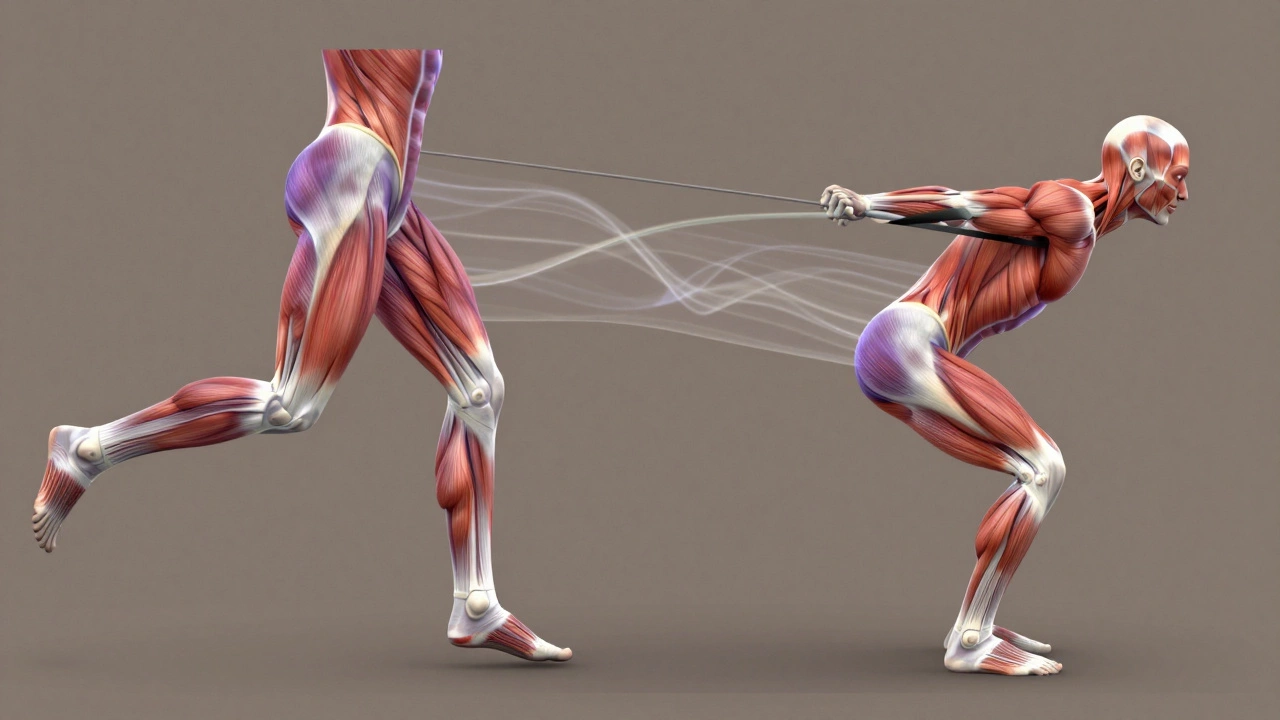
- Bodyweight and resistance bands: Single-leg squats, lunges, glute bridges, and step-ups build functional strength without adding bulk.
- Explosive movements: Box jumps, kettlebell swings, and resisted sprints train your fast-twitch fibers to fire quickly - not grow.
- Core stability: Planks, dead bugs, and bird-dogs keep your posture locked during long runs. A weak core? That’s where form breaks down at mile 20.
One runner in Bristol, Mark, went from 18% body fat to 12% while adding 6 pounds of muscle over 10 months. His secret? He lifted 3x a week - 30 minutes max - and never went over 70% of his max lift. He ran 4x a week. He didn’t bulk up. He tightened up. He ran his first marathon in 3:18 - 22 minutes faster than his previous attempt.
What Happens If You Overdo the Weights?
It’s possible to build too much muscle for running. Signs you’ve gone too far:
- Your legs feel heavy on easy runs
- You’re constantly sore, even after light jogging
- Your VO2 max is dropping despite more running
- You’re gaining weight, not just muscle
When muscle mass increases beyond what your cardiovascular system can support, your body starts treating every run like a recovery day. That’s not training - that’s damage.
Strength training should enhance your running, not drain it. If you’re lifting heavy and feeling exhausted before your long run, you’re doing it wrong.
How Nutrition Plays Into Both Goals
You can’t build muscle and run marathons on the same diet as a bodybuilder or a pure endurance athlete. You need a hybrid.
Here’s what works:
- Protein: 1.6-2.0 grams per kilogram of body weight. Enough to repair muscle, not enough to pack on bulk.
- Carbs: Your main fuel. Aim for 6-8 grams per kg on heavy training days. Marathon runners burn 2,500-3,500 calories on long runs. You need carbs to refill glycogen.
- Fats: Don’t fear them. Healthy fats from nuts, avocados, and fish help hormone balance - which matters for muscle recovery.
- Timing: Eat protein within 30 minutes after lifting. Eat carbs within 20 minutes after a long run.
One runner I spoke to in Bath, Sarah, tracked her intake for six months. She ate 120g of protein daily (about 180 lbs body weight) and 400g of carbs on long-run days. She didn’t gain fat. She didn’t lose strength. She ran a 3:05 marathon - her best ever - and deadlifted 185 lbs. She didn’t choose between muscle and miles. She balanced both.

Real Examples: Who’s Done This?
Look at elite athletes, not just amateurs.
- David Goggins: Former Navy SEAL, ultra-endurance athlete, and 4-time 100-mile runner. He’s built like a linebacker - and he’s done it while maintaining sub-6-minute mile pace.
- Geoffrey Mutai: Boston Marathon winner. He’s lean, but his leg strength comes from years of hill sprints and plyometrics - not just running.
- Many Ironman triathletes: These athletes swim, bike, and run 140.6 miles. Many of them have visible abs, strong shoulders, and thick thighs. They don’t look like marathoners. They look like athletes.
The pattern? They train smart. They don’t try to be bodybuilders or pure endurance athletes. They’re hybrid athletes.
Training Plan: 12 Weeks to Be Stronger and Faster
Here’s a simple, real-world plan you can start tomorrow:
- Monday: Easy 5-mile run
- Tuesday: Strength (30 mins): 3 sets of squats, lunges, planks, pull-ups
- Wednesday: Rest or yoga
- Thursday: Tempo run (4 miles at goal marathon pace)
- Friday: Strength (30 mins): Glute bridges, single-leg deadlifts, core circuit
- Saturday: Long run (start at 10 miles, build to 20)
- Sunday: Active recovery (walk, swim, or foam roll)
Do this for 12 weeks. Keep protein high. Keep carbs high on long-run days. Keep lifting light and fast. You’ll get stronger. You’ll run faster. And you won’t look like a bodybuilder.
Final Answer: Yes - But With Conditions
Can you be muscular and run a marathon? Absolutely. But you can’t do it by accident. You can’t just lift heavy and run long. You need structure.
You need to understand that muscle isn’t the enemy - poor training is. The right strength work makes you more efficient, less injury-prone, and mentally tougher. It helps you hold form when your legs scream at mile 22.
Marathons aren’t won by the lightest runners. They’re won by the most resilient ones. And resilience comes from strength - not just miles.
Stop thinking you have to be skinny to run far. Start thinking: how strong can you be - without slowing down?
Can you gain muscle while training for a marathon?
Yes, but only if you’re new to strength training or have significant muscle loss from prior inactivity. For experienced runners, muscle gain is unlikely - but strength and efficiency can still improve. Focus on maintaining lean muscle with low-volume, high-quality lifting, not bulking up.
Will lifting weights slow me down in a marathon?
Only if you’re doing heavy bodybuilding-style workouts with long rest periods and high volume. Smart strength training - short, controlled, and focused on functional movement - actually makes you faster by improving running economy and reducing injury risk.
How often should I lift weights while training for a marathon?
Two sessions per week, 30 minutes each, is ideal. Do them on non-long-run days. Avoid lifting the day before a long run or a race. Focus on compound movements and core stability - not isolation exercises.
Do I need to eat more protein to build muscle while running?
Yes, but not dramatically more. Aim for 1.6-2.0 grams of protein per kilogram of body weight daily. More than that won’t build extra muscle - it’ll just turn into fat if you’re not burning enough calories. Timing matters: have protein within 30 minutes after lifting.
What’s the best strength exercise for marathon runners?
Single-leg deadlifts. They build glute and hamstring strength, improve balance, and mimic the running motion. They also strengthen your posterior chain - the area most runners neglect. Do 3 sets of 10 per leg with light to moderate weight.