
How Long Does Rugby Last? Match Duration Explained
Rugby Match Duration Estimator
Estimated Real-Time Duration
Total Viewing Time:
Breakdown
- Playing Time:
- Halftime:
- Stoppages & Reviews:
- Extra Time:
Select options and click "Estimate Duration" to see how long your Sunday afternoon will last.
You sit down with your beer, settle into the sofa, and check the clock. The whistle blows. You assume you have an hour and twenty minutes to kill before the final huddle. But then the first half drags on, penalties pile up, and suddenly it’s been forty-five minutes of play for what was supposed to be forty. If you’ve ever wondered how long does rugby last, you’re not alone. It’s one of the most common questions from new fans, parents scheduling their kids’ games, and even casual viewers trying to plan their Sunday.
The short answer? A standard professional rugby union match lasts 80 minutes of playing time, split into two 40-minute halves. But here’s the kicker: that’s just the clock time. Real-world duration includes halftime, injury time, and stoppages. So, if you’re planning your evening, block out about two hours and ten minutes. If you’re watching a youth game or a sevens tournament, the math changes completely. Let’s break down exactly what eats up your time, why the clock never really stops, and how different formats shift the schedule.
The Standard Professional Match Timeline
In rugby union-the version played in the Six Nations, Premiership, and World Cup-the structure is rigid but deceptive. The referee controls a single game clock. They blow the whistle to start each half. When the ball goes out of play, for a lineout, scrum, or penalty, the clock usually keeps running. This is crucial. Unlike American football or basketball, where every stop freezes the timer, rugby relies on "running time." This means a 40-minute half can easily stretch to 50 or 55 minutes of real-time viewing because of breakdowns, TMO (Television Match Official) reviews, and injuries.
Here is the typical breakdown for a top-tier match:
- Pre-match warm-ups: Players are on the field for 15-20 minutes before kickoff. This isn’t counted in the 80 minutes, but it’s part of the broadcast window.
- First Half: 40 minutes of play. With stoppages, this often takes 50-60 minutes of real time.
- Halftime Interval: Strictly 10 minutes. Teams retreat to locker rooms; broadcasters run analysis segments. You cannot extend this significantly without official approval.
- Second Half: Another 40 minutes of play. Again, expect 50-60 minutes of real time due to fatigue-induced errors and more frequent penalties.
- Injury Time (Stoppage Time): Added at the end of each half. Referees add time lost to injuries, substitutions, or lengthy TMO checks. This is rarely announced precisely until it happens, adding unpredictability.
If you add it all up, a live attendance experience or TV broadcast typically spans 110 to 130 minutes. Why the variance? High-tempo games with few penalties might finish closer to 110 minutes. A gritty, physical match with multiple head-injury assessments and scrum resets could push past 125 minutes.
Rugby Sevens: The Fast-Paced Alternative
If you find traditional rugby too slow, or if you’re looking for something quicker, Rugby Sevens is a variant of rugby union played by teams of seven players instead of fifteen. It’s an Olympic sport now, and its timing reflects that speed. A Sevens match is drastically shorter. Each half is only 7 minutes long. That’s right-fourteen minutes of total playing time.
But don’t let the small number fool you. Because the game is so fast, stoppages still occur. However, the total event duration is much tighter. A full Sevens match, including halftime (which is usually just 2 minutes), takes roughly 20 to 25 minutes of real time. This makes Sevens tournaments incredibly efficient for spectators. You can watch three or four matches in the time it takes to get through one Union game. The World Rugby Sevens Series often schedules back-to-back finals within a single afternoon, keeping the energy high and the attention span engaged.
Age-Grade and Amateur Variations
Not everyone is playing at Twickenham or Eden Park. If you’re a parent driving a child to a local club in Bristol or elsewhere, the durations differ based on age groups. These rules exist to protect developing bodies and maintain engagement levels for younger minds. Here’s how the landscape shifts for non-professionals:
| Format/Level | Playing Time | Estimated Total Duration | Key Notes |
|---|---|---|---|
| Professional Union | 80 mins (2 x 40) | 110-130 mins | Includes TMO reviews and injury time. |
| Rugby Sevens | 14 mins (2 x 7) | 20-25 mins | Fast-paced; minimal halftime. |
| Under-18 | 60-70 mins | 90-100 mins | Often 2 x 30 or 2 x 35 mins depending on league. |
| Under-16 | 50-60 mins | 80-90 mins | Focused on skill development; fewer stoppages. |
| Mini Rugby (U12) | 20-30 mins | 40-50 mins | Short bursts; frequent rotations. |
For U18s, leagues vary. Some use 35-minute halves, others stick to 30. The RFU (Rugby Football Union) guidelines suggest reducing intensity as age decreases. By the time you hit Mini Rugby, the focus is entirely on participation. Games are often structured as festivals rather than timed matches, meaning "how long" becomes less about the clock and more about the session slot, usually lasting 45 minutes to an hour including breaks.
Why Does the Clock Keep Running?
This is the biggest point of confusion for newcomers coming from soccer or American sports backgrounds. In rugby, the referee does not stop the clock when the ball is kicked into touch (out of bounds). The clock continues ticking while players jog to the lineout, form the formation, and execute the throw. This rule exists to keep momentum flowing and prevent tactical stalling. If the clock stopped every time a player went down, a game could easily stretch to three hours.
However, there are exceptions where the clock does stop or pauses effectively:
- Head Injury Assessments (HIA): Since 2023, protocols require immediate removal of players suspected of concussion. While the clock may technically continue, the subsequent review process often adds significant time via added injury time later.
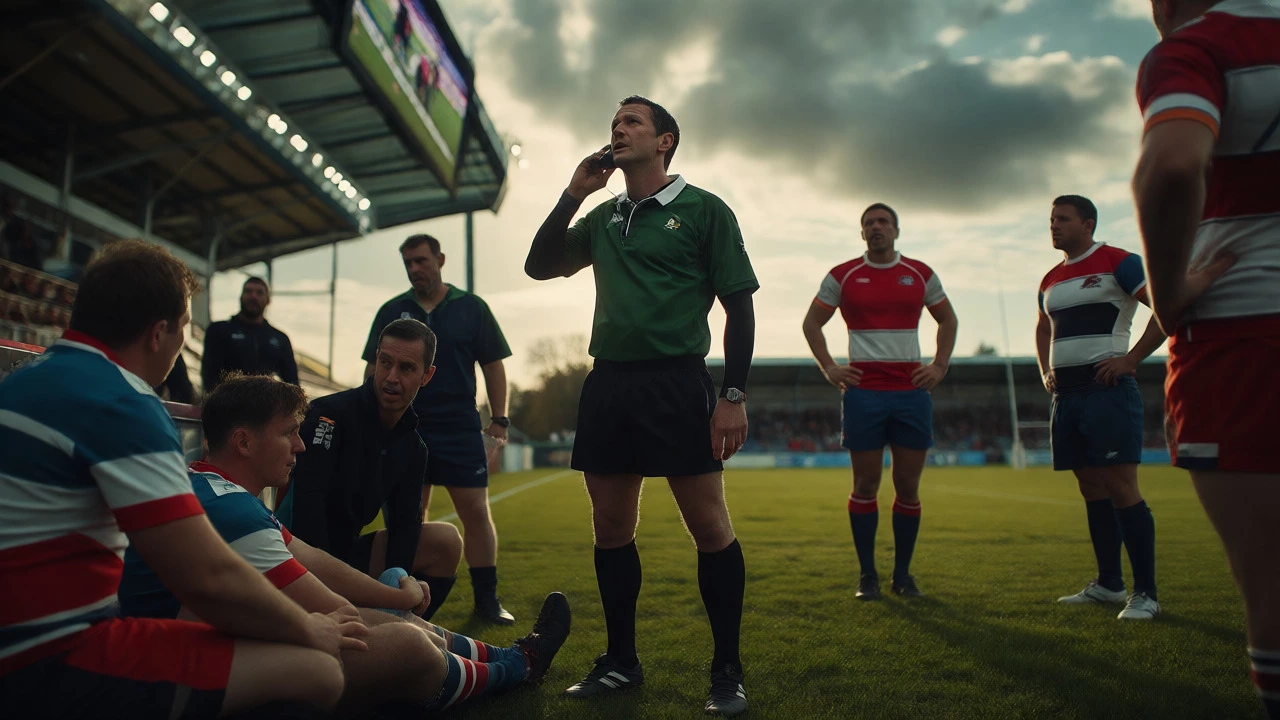
- TMO Reviews: For try decisions or foul play, the referee consults the video official. The clock keeps running during this review, which frustrates coaches but maintains pressure. If the review is complex, the referee will add that time back at the end of the half.
- Scrum Resets: If a scrum collapses repeatedly, the referee may order a reset. The clock runs, but if it becomes excessive, they might pause briefly to manage safety, though this is rare.
Understanding this helps you predict the end time. If you see a team kicking for territory constantly, forcing lineouts, the clock will tick away faster than if the team keeps the ball alive in open play. Strategic kicking can actually shorten the perceived length of the match for the trailing team.
Broadcast Windows vs. Actual Play
If you’re tuning in on TV, remember that the broadcast window is wider than the match itself. Networks like TNT Sports or Sky Sports allocate specific slots. A 3:00 PM kick-off might mean coverage starts at 2:45 PM with pre-match analysis and ends around 5:15 PM with post-match interviews. Always pad your schedule by 15 minutes on either side. Also, note that weather delays can push these windows. Heavy rain doesn’t stop play, but lightning does. If play is suspended for thunderstorms, the match resumes once the all-clear is given, potentially extending the day’s schedule by an hour or more.
Common Misconceptions About Rugby Timing
Let’s clear up a few myths. First, many people think rugby has quarters like American football. It doesn’t. There are only two halves. Second, some believe that if the ball is in play when the whistle blows, the play continues until the ball dies. This is true for the very last second of a half, but generally, the referee blows the whistle to signal the end of the period. Any penalty awarded after the whistle is usually taken as a free kick unless it’s a specific advantage situation managed by the ref.
Another misconception involves "extra time." In knockout tournaments like the World Cup, if scores are level after 80 minutes, there is no sudden death immediately. Instead, there are two five-minute periods of extra time. If still tied, a drop-goal shootout decides the winner. This can add another 15-20 minutes to the total duration. So, always check if it’s a pool stage game (no overtime) or a knockout (potential overtime).
Practical Tips for Spectators
Whether you’re at the stadium or watching from home, here’s how to handle the timing:
- Arrive Early: For live games, arrive 30 minutes before kickoff to catch the national anthems and warm-ups. The atmosphere builds during this time.
- Plan Bathroom Breaks: Halftime is your only guaranteed 10-minute break. Use it wisely. During the halves, leave the seat only if necessary, as re-entry can be tricky in crowded stands.
- Watch the Referee’s Watch: Experienced fans glance at the ref’s wristwatch periodically. It gives a rough idea of how much time is left in the current half, accounting for any visible stoppages.
- Expect Delays in Finals: Championship finals often have longer ceremonies, VIP introductions, and extended halftime shows. Add 15 minutes to the standard estimate for major finals.
Does the clock stop when a player is injured in rugby?
No, the clock does not automatically stop for minor injuries. It continues running. However, if a player requires significant medical attention or a Head Injury Assessment, the referee will add that lost time as injury time at the end of the half. For severe incidents requiring ambulance access, play may be suspended temporarily.
How long is halftime in a professional rugby match?
The standard halftime interval in professional rugby union is 10 minutes. This allows players to receive medical treatment, hydrate, and listen to coaching instructions. Broadcasters often fill this time with analysis segments, but the actual break between halves remains strictly regulated to ensure fairness.
Is Rugby Sevens shorter than Rugby Union?
Yes, significantly. A Rugby Sevens match consists of two 7-minute halves, totaling 14 minutes of playing time. Including halftime and stoppages, a complete Sevens match typically lasts between 20 and 25 minutes, compared to the 110-130 minutes required for a full Union match.
What happens if a rugby match is tied at the end of regular time?
In pool stages of tournaments, a draw is recorded, and the match ends. In knockout competitions, such as the World Cup, two periods of 5-minute extra time are played. If the score remains level after extra time, a drop-goal shootout determines the winner. This can extend the match duration by approximately 15-20 minutes.
Do referees announce how much injury time is added?
Unlike football, rugby referees do not hold up a board showing exact injury time minutes. They signal additional time verbally or by pointing to their watch, but the amount is discretionary. Coaches and players must adapt dynamically, knowing that time may be added silently at the end of each half.