
Tennis Scoring Explained: What Do 15 and 30 Mean?
Tennis Score Simulator
Simulate a single tennis game to understand how scores progress from Love to Game, including Deuce and Advantage scenarios.
| Points Won | Tennis Call | Status |
|---|---|---|
| 0 | Love | No points yet |
| 1 | 15 | First point |
| 2 | 30 | Second point |
| 3 | 40 | Third point (Game Point if opponent < 40) |
| Deuce | Deuce | Both at 40 (or equal after Ad) |
| Advantage | Ad-In / Ad-Out | One point ahead after Deuce |
You are watching a match on Centre Court or maybe just playing with friends at the local park. The umpire calls out "Love-15." Then it becomes "15-All." Suddenly, one player hits a winner, and the call changes to "15-30." If you have ever sat there scratching your head wondering why they aren't counting 1, 2, 3, you are not alone. It is arguably the most confusing part of tennis for newcomers, but once you crack the code, it is surprisingly simple.
The numbers 15 and 30 are not arbitrary. They are specific point values within a single game. Understanding them is the key to following any match, from Wimbledon finals to weekend league games. Let's break down exactly what these numbers mean, where they came from, and how they fit into the bigger picture of winning a set.
The Basic Point System: 0, 15, 30, 40
In tennis, a game is won by the first player to win four points, provided they are two points ahead. But we don't say "one," "two," or "three." We use a quirky system that dates back centuries. Here is the translation guide:
- Love (0): No points won yet.
- 15: One point won.
- 30: Two points won.
- 40: Three points won.
Why stop at 40? Why not 45? This is where things get interesting. When a player reaches 40, they are one point away from winning the game-unless their opponent also has 40. That scenario is called Deuce. At Deuce, you need to win two consecutive points to take the game. The first point after Deuce gives you Advantage (often shortened to "Ad"). If you win the next point, you win the game. If you lose it, you go back to Deuce.
| Points Won | Tennis Call | Status |
|---|---|---|
| 0 | Love | Starting line |
| 1 | 15 | First point scored |
| 2 | 30 | Second point scored |
| 3 | 40 | Game point (if opponent has <40) |
| 4+ | Game / Ad-In / Ad-Out | Winning zone |
How to Read the Score Correctly
Now that you know 15 means one point and 30 means two, how do you listen to the umpire? The order matters. The server’s score is always announced first. So, if the scoreboard says "15-30," it means the server has 15 (one point) and the receiver has 30 (two points). The receiver is leading in this game.
If both players have won one point, the score is "15-All" or sometimes just "Both 15." If the server wins the next point, it becomes "30-15." Notice how the server’s number jumps from 15 to 30. This can feel counterintuitive if you expect linear counting, but stick with it. The jump from 30 to 40 is the final step before the critical decision point.
Let’s walk through a realistic scenario. You are serving. You hit an ace. The umpire calls "15-Love." Your opponent returns a shot you miss. Now it is "15-15." You double-fault. The score moves to "15-30." Your opponent is now one point away from breaking your serve. You manage to win the next point with a great forehand. Now it is "30-30." Tension rises. You win again. "40-30." This is Game Point for you. Win it, and you take the game. Lose it, and it goes to "40-40," which is Deuce.

Where Did These Weird Numbers Come From?
Honestly, nobody knows for sure. Tennis historians have debated this for decades. There are three main theories, and while none are proven, they offer a fascinating glimpse into the sport's history.
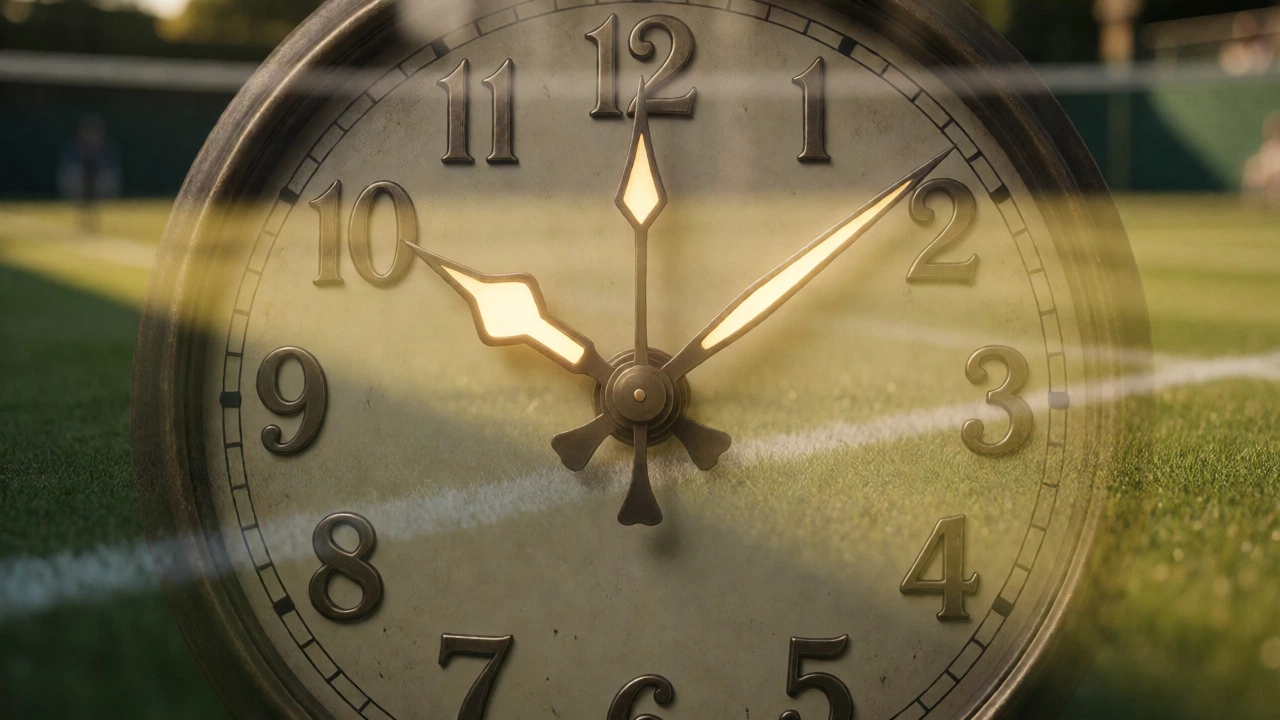
The most popular theory involves a clock face. In medieval France, early forms of tennis were played in monastery courtyards. To keep score, players might have used a clock dial divided into quarters. Moving the hand from 0 to 15, then 30, then 45 made sense visually. Over time, saying "45" became cumbersome, so it was shortened to "40." This allowed for the concept of Deuce-if you were tied at 40 (which would technically be 45), you couldn't just win by one point because the clock had no room for a fifth quarter without resetting.
Another theory suggests French origins with the word "l'oeuf" (egg), meaning zero, which sounded like "love" to English speakers. As for the 15s, some argue it comes from betting stakes. Early gamblers might have placed bets of 15 sous per point. Winning a point meant collecting 15 units of currency. While plausible, this doesn't fully explain the shift to 40.
A third, less likely theory ties it to court dimensions. Some believe the original courts were 45 feet wide, and points were awarded based on distance advanced. However, modern analysis of historical texts makes the clock-face theory the strongest contender among scholars.
Why Does Advantage Exist?
You might wonder why tennis requires a two-point margin instead of just being first-to-four. Imagine if the score reached 3-3 (or 40-40) and the next point simply decided the game. Matches could end on lucky bounces or minor errors. The requirement to win by two points ensures that the better player usually prevails over a short burst of luck.
This rule creates those legendary long games. Remember when Isner and Mahut played that epic Wimbledon match in 2010? The final set went to 70-68. That happened because neither player could secure a two-point lead for hours. Without the Deuce and Advantage rules, matches would be shorter but potentially less fair.
However, professional tournaments have started changing this to speed up play. Many ATP and WTA events now use "No-Ad" scoring. In this format, if the score reaches 40-40, the next point decides the game. The receiver chooses whether to receive the serve from the deuce or ad court. This eliminates the endless back-and-forth of Advantage, making matches more predictable for broadcasters and fans.

From Games to Sets and Matches
Understanding 15 and 30 is just step one. You need to see how these points build into sets. A standard set is won by the first player to win six games, with a two-game lead. If the set reaches 6-6, a tie-break is usually played.
Inside a tie-break, the scoring changes completely. Instead of 15, 30, 40, players count actual points: 1, 2, 3, 4... up to 7. The first to seven points, winning by two, takes the set. This abrupt switch can confuse viewers who are used to the traditional rhythm. Just remember: regular games use 15/30/40; tie-breaks use real numbers.
Most professional matches are best-of-three sets for women and best-of-five for men in Grand Slams. So, winning a game (those precious 15s and 30s) is a small battle in a much larger war. Each game you hold (win on your own serve) keeps you safe. Each break (win on the opponent's serve) puts pressure on them.
Common Mistakes Newcomers Make
When you start playing or watching, you will make mistakes. Here are the big ones:
- Confusing Server Order: Always listen for the server's score first. If you are the receiver and hear "30-15," you are behind.
- Forgetting the Two-Point Rule: Don't celebrate at 40-30 until the ball actually lands in. One mistake resets everything to Deuce.
- Misinterpreting "Love": Love isn't affection; it's zero. "Love-15" means the server has nothing, and the receiver has one point.
- Ignoring Tie-Break Rules: Don't try to apply 15/30 logic inside a tie-break. Count normally.
Practicing helps. Next time you play a practice game, announce the scores out loud using the correct terms. Say "Fifteen-Love" instead of "One-Zero." It feels silly at first, but it builds muscle memory. Soon, you'll instinctively know that reaching 40 means you are one step away from victory, provided you maintain that two-point buffer.
Why is zero called "Love" in tennis?
The term likely derives from the French word "l'oeuf," meaning egg, which resembles the shape of a zero. English speakers misheard it as "love." Another theory suggests it comes from playing for the love of the game, with no score initially. Regardless of origin, "Love" universally signifies zero points in tennis scoring.
What happens if the score is 40-40?
This score is called "Deuce." At Deuce, a player must win two consecutive points to win the game. Winning the first point after Deuce gives them "Advantage" (Ad-In if serving, Ad-Out if receiving). If they win the next point, they win the game. If they lose it, the score returns to Deuce.
Do all tennis matches use 15, 30, 40 scoring?
Most traditional matches do. However, many professional tournaments now use "Fast4" or "No-Ad" formats to shorten match times. In No-Ad, if the score reaches 40-40, the next point decides the game. Tie-breaks also use standard numerical counting (1, 2, 3...) rather than the 15/30/40 system.
Who serves first in a game?
The player whose turn it is to serve starts each game. Service alternates every game throughout the set. Within a game, the same player serves every point. The score announcement always lists the server's points first, followed by the receiver's points.
Why isn't the third point called 45?
Historical theories suggest the scoring may have originated from a clock face marked in quarters (15, 30, 45). Saying "forty-five" was considered too long or awkward compared to "forty," so it was shortened. Additionally, stopping at 40 allows for the clear distinction of Deuce situations where a two-point margin is required.