
The Big 3 Gym Workouts: Squats, Deadlifts, and Bench Press Explained
Big 3 Workout Routine Builder
Step 1: Select Your Focus Exercises
Choose which of the Big 3 exercises you want to focus on this week. You can select all three or just one or two.
Back Squat
King of lower body exercises
Deadlift
Ultimate full-body pull
Bench Press
Upper body powerhouse
Step 2: Choose Your Training Frequency
Quick Tips
- Warm-up first: Always start with 5-10 minutes of light cardio and dynamic stretches.
- Form over weight: Prioritize proper technique before adding heavy loads.
- Progressive overload: Gradually increase weight, reps, or sets over time.
- Rest between sets: Take 2-3 minutes rest between heavy sets.
You walk into the gym, look around, and see people lifting heavy weights with intense focus. You might wonder what makes those specific movements so special. The answer lies in a concept known as the "Big 3" gym workouts. These aren't just random exercises; they are the foundational pillars of strength training for millions of lifters worldwide. Whether you are looking to build muscle, increase raw strength, or simply improve your overall physical health, understanding these three moves is essential.
The Big 3 refers specifically to the squat, the deadlift, and the bench press. Together, they form the core of powerlifting competitions and serve as the backbone for most general strength programs. Why these three? Because they are compound movements that recruit multiple muscle groups simultaneously, allowing you to move more weight than any isolation exercise like a bicep curl or leg extension. If you want efficient results without spending hours at the gym, mastering these lifts is your best bet.
Why the Big 3 Matter More Than Isolation Exercises
Before we break down each movement, it helps to understand why these exercises hold such prestige. In the world of fitness, exercises are generally divided into two categories: compound and isolation. An isolation exercise targets one specific joint and muscle group, such as a lateral raise for shoulders. A compound exercise, on the other hand, involves multiple joints and muscle groups working together.
The Big 3 are the ultimate compound movements. When you perform a squat, you are not just working your quads. Your glutes, hamstrings, lower back, core, and even your upper back muscles engage to stabilize the barbell. This systemic demand triggers a significant hormonal response, releasing testosterone and growth hormone, which aids in muscle building across your entire body. It is far more time-efficient to do five sets of squats than to do separate sets for legs, hips, and core.
| Feature | Big 3 (Compound) | Isolation (e.g., Leg Extension) |
|---|---|---|
| Muscle Groups Involved | Multiple (Full Body or Lower/Upper Half) | Single Muscle Group |
| Calorie Burn | High due to large muscle mass engagement | Low to Moderate |
| Functional Strength | High (Mimics real-world movements) | Low (Specific to machine path) |
| Time Efficiency | High (More work per minute) | Low (Requires more exercises for full coverage) |
The Back Squat: King of All Exercises
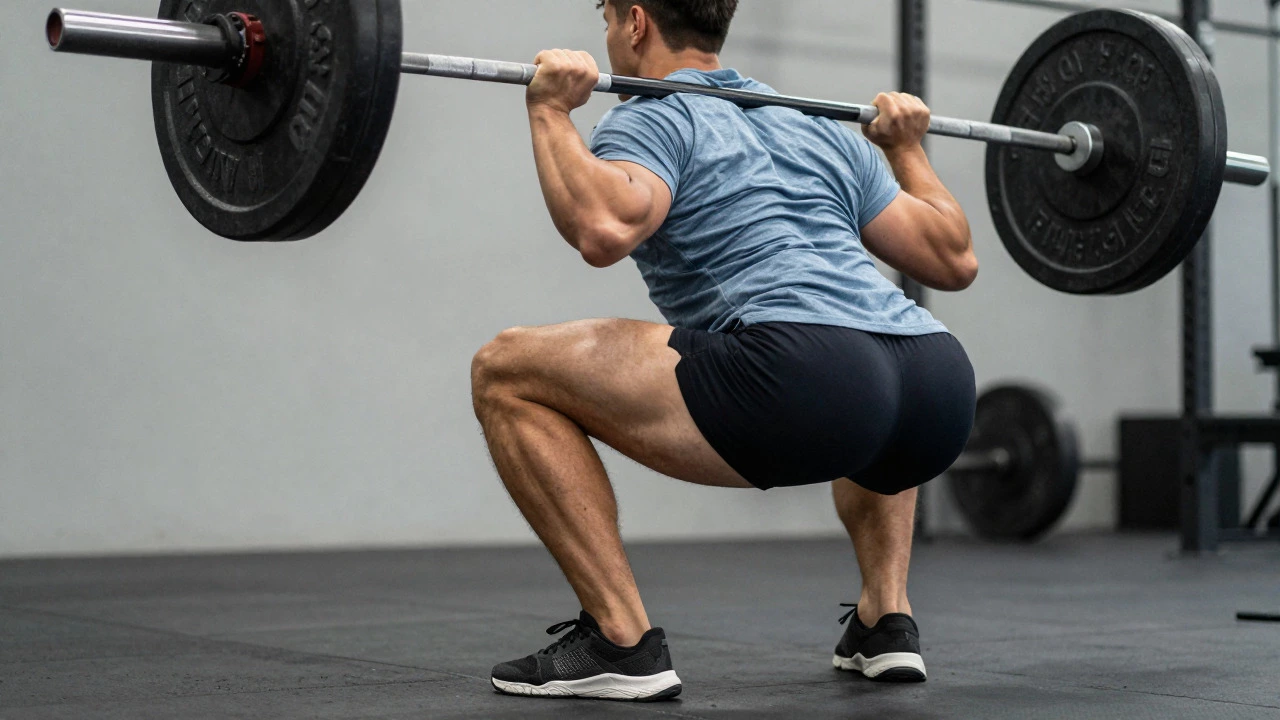
If there is a single exercise that defines lower-body strength, it is the back squat. Often called the "king of exercises," the squat builds massive amounts of muscle in your legs and glutes while demanding serious stability from your core and upper back. It mimics the fundamental human movement of sitting down and standing up, making it highly functional for daily life.
To perform a proper back squat, you place a barbell across your upper traps (the muscles at the top of your shoulders). You then descend by pushing your hips back and bending your knees until your thighs are at least parallel to the floor. From there, you drive through your heels to return to a standing position. The key here is keeping your chest up and your spine neutral. If you round your back, you risk injury to your lumbar spine.
Common mistakes beginners make include letting their knees cave inward or not going deep enough. Shallow squats reduce the range of motion and limit the benefits. Aim for "ass to grass" depth if your mobility allows it, but prioritize form over depth initially. As you get stronger, consider using squat shoes or lifting with slight elevation under your heels to help with ankle mobility.
The Deadlift: The Ultimate Full-Body Pull
While the squat focuses on pushing weight away from your body via the legs, the deadlift is about pulling weight toward you. It is arguably the most practical strength exercise because it teaches you how to pick things up off the ground safely. Whether you are moving furniture or lifting groceries, the mechanics of the deadlift apply directly to real-world scenarios.
The deadlift primarily targets your posterior chain-the muscles on the back side of your body, including your hamstrings, glutes, lower back, and lats. To execute it, you stand with your feet hip-width apart, gripping a barbell on the floor. Hinge at your hips, keep your back flat, and drive through your legs and hips to lift the bar until you are standing tall. Then, reverse the motion to lower the bar back to the ground.
A critical point to remember is that the deadlift is not a squat. Many beginners try to squat out of the deadlift, which puts unnecessary strain on the knees and reduces hip engagement. Think of it as a hinge movement. Your shins should remain relatively vertical, and the movement should be driven by your hips snapping forward. Rounding your lower back under heavy load is the most common cause of deadlift injuries, so always brace your core tightly before initiating the pull.
The Bench Press: Upper Body Powerhouse
The third pillar of the Big 3 is the bench press, which is the primary exercise for upper-body pushing strength. It mainly works your pectorals (chest), anterior deltoids (front shoulders), and triceps. While it might seem less functional than the squat or deadlift, the bench press builds crucial upper-body strength that supports posture, pushing capabilities, and overall athletic performance.
Performing a safe and effective bench press requires attention to detail. Lie flat on a bench with your eyes directly under the bar. Grip the bar slightly wider than shoulder-width. Before unracking the bar, set your scapula (shoulder blades) by pulling them back and down, creating a stable platform on your back. Plant your feet firmly on the floor and maintain a slight arch in your lower back.
Lower the bar to your mid-chest, touching it lightly before pressing it back up explosively. A common error is flaring the elbows out to 90 degrees, which places excessive stress on the shoulder joints. Instead, tuck your elbows at about a 45-degree angle relative to your torso. This alignment protects your shoulders and allows your triceps and chest to share the load more effectively.
How to Incorporate the Big 3 Into Your Routine
Knowing what the Big 3 are is one thing; knowing how to train them is another. You don't need to squat, deadlift, and bench press every single day. In fact, doing so would likely lead to overtraining and burnout. These are high-intensity movements that require significant recovery time.
A standard approach for beginners is to follow a full-body routine performed three times a week. For example:
- Monday: Squat, Bench Press, Rows
- Wednesday: Deadlift, Overhead Press, Pull-ups
- Friday: Squat, Bench Press, Lunges
As you advance, you might switch to an upper/lower split or a dedicated powerlifting program. The key principle remains progressive overload. This means gradually increasing the weight, reps, or sets over time. If you bench press 100 pounds for 10 reps this week, aim for 105 pounds next week or 100 pounds for 11 reps. Without this gradual increase, your body has no reason to adapt and grow stronger.
Safety First: Warming Up and Form Checks
Because the Big 3 involve heavy loads, safety should be your top priority. Never jump straight into your heaviest set. Always start with a warm-up. Begin with 5-10 minutes of light cardio to increase blood flow, followed by dynamic stretches like arm circles, leg swings, and bodyweight squats.
When loading the bar, use empty bar sets first. Perform 10-15 reps with just the barbell to groove the movement pattern. Then, add small increments of weight until you reach your working set. If you are lifting near your maximum capacity, consider using spotter arms on the squat rack or having a training partner watch your form. Ego lifting-trying to impress others by lifting too much too soon-is the fastest way to end your fitness journey with an injury.
Alternatives for Beginners or Those With Injuries
Not everyone can immediately perform the traditional Big 3 due to equipment limitations, injuries, or mobility issues. That is perfectly fine. There are excellent alternatives that provide similar benefits.
If the barbell squat feels awkward or painful on your shoulders, try goblet squats holding a dumbbell or kettlebell at chest height. This variation encourages an upright torso and is easier on the lower back. For deadlifts, Romanian deadlifts (RDLs) using dumbbells are a great alternative that emphasizes the hamstrings and glutes with less spinal loading. And if the bench press aggravates your shoulders, push-ups or dumbbell floor presses can build comparable chest and tricep strength with a greater range of motion.
Can I build muscle only by doing the Big 3?
Yes, you can build a significant amount of muscle using only the Big 3. These compound movements stimulate large muscle groups and trigger strong hormonal responses. However, for aesthetic balance, you may eventually want to add some isolation exercises to target smaller muscles like biceps, calves, or side delts that aren't fully exhausted by the main lifts.
How often should I train the Big 3?
For most natural lifters, training each of the Big 3 two to three times per week is optimal. This frequency provides enough stimulus for growth while allowing adequate recovery. Beginners often benefit from higher frequency (full-body workouts 3x a week), while advanced lifters might specialize with lower frequency but higher intensity.
Do I need a spotter for the Big 3?
A spotter is highly recommended for the bench press and squats when lifting near your failure point. For deadlifts, a spotter is less common unless you are attempting a personal record. If you train alone, use safety bars in the squat rack and learn how to bail safely off a deadlift if the weight becomes unmanageable.
Which of the Big 3 is the hardest?
Subjectively, many lifters find the deadlift the most technically demanding and physically taxing because it engages the entire posterior chain and requires precise setup. However, the squat is often considered the most difficult due to the high level of mobility and stability required. Difficulty varies based on individual anatomy and experience.
Can women benefit from the Big 3?
Absolutely. The Big 3 are not gender-specific. Women who incorporate squats, deadlifts, and bench presses into their routines often see dramatic improvements in strength, bone density, and body composition. Contrary to popular myth, lifting heavy weights will not make women bulky; it creates a toned, strong physique.