
What is a Boxing Victory Called? Understanding KO, TKO, and Decisions

Boxing Outcome Identifier
Click a scenario below to see the official boxing terminology for that outcome.
Fighter Falls
The fighter is knocked down by a punch. The referee starts counting. The fighter tries to stand but fails before the count reaches ten.
Helpless Fighter
The fighter is still standing but taking heavy shots without defending. The referee waves his arms horizontally and stops the fight immediately.
Towel Thrown
Between rounds, the trainer throws a towel into the ring to signal they want to quit. The fighter is not knocked down.
Judges Agree
The fight goes all 12 rounds. All three judges score the bout in favor of the same boxer.
Illegal Hit
A fighter lands an illegal blow (e.g., low blow) repeatedly after warnings. The referee disqualifies them.
Cut & Headbutt
An accidental clash of heads causes a severe cut early in round 2. The doctor says the fight cannot continue.
You’re watching a fight. The bell rings, the referee waves his arms, and one fighter stands while the other lies on the canvas. The announcer shouts something like "Knockout!" But what if the ref stops it before the count of ten? Or what if both guys go the distance, and the judges have to pick a winner? If you’ve ever found yourself confused by the jargon flying around the ring, you aren’t alone. Boxing victories come in several distinct flavors, each with its own rules, history, and dramatic weight.
This guide breaks down exactly what a boxing win is called, how it happens, and why the distinction matters. Whether you’re new to the sport or just want to sound smarter during Sunday night pay-per-views, understanding these outcomes changes how you watch the action.
The Quick Breakdown: Types of Wins
Before we get into the nitty-gritty, here’s the cheat sheet. A boxing match ends in one of three main ways:
- Knockout (KO): The fighter is knocked down and cannot rise before the referee counts to ten.
- Technical Knockout (TKO): The referee, cornermen, or doctor stop the fight because continuing would cause unnecessary damage, even if the fighter isn’t technically unconscious.
- Decision: The fight goes the full scheduled rounds (usually 10, 11, or 12), and judges score the points to determine a winner.
There are rarer outcomes too-like disqualifications or no contests-but these three cover 95% of professional bouts. Let’s unpack them.
The Knockout (KO): The Ultimate Finish
A Knockout, often abbreviated as KO, is the most famous outcome in combat sports. It happens when a punch causes a fighter to fall to the canvas, and they fail to answer the referee’s count of ten in a standing position. The key word here is "standing." You can be up at eight but wobble at nine? That’s still a KO.
Historically, the KO was the gold standard of dominance. Think Mike Tyson in the late 80s or Deontay Wilder today. Their reputation was built on the threat of this single outcome. When a fighter gets KO’d, it’s not just a loss; it’s a physical admission that their defense failed catastrophically.
Here’s a common misconception: Does a KO mean the fighter was unconscious? Not always. Many fighters take a knee from sheer shock or balance issues without losing consciousness. As long as they don’t rise before ten, it’s a KO. The rule exists to protect the fighter from taking more punishment when they clearly can’t defend themselves.
The Technical Knockout (TKO): Stopping the Damage
If the KO is about failure to rise, the Technical Knockout (TKO) is about prevention. This is where things get subjective, and sometimes controversial.
A TKO occurs when the referee decides a fighter can no longer intelligently defend themselves. Maybe they’re getting hammered against the ropes. Maybe they’re taking clean shots to the head without flinching. The ref steps in and waves off the fight. No count needed. The fighter might be perfectly conscious, maybe even angry, but the ref sees danger and hits the pause button.
There are actually different types of TKOs, though they all end up on the record as "TKO":
- Referee Stoppage: The most common type. The official feels the fighter is helpless.
- Corner Retirement: Your trainer throws in the towel. They see blood, swelling, or exhaustion and decide enough is enough.
- Doctor Stoppage: A cut is so bad it impairs vision, or there’s visible damage that risks permanent injury. The ringside doctor advises stopping it.
- Three Knockdown Rule: In some jurisdictions, if a fighter gets dropped three times in one round, the fight is automatically stopped, regardless of whether they got up.
Why does this matter? Because a TKO looks less brutal than a KO on paper, but it can sometimes indicate worse damage. A fighter who stays on their feet while absorbing heavy shots might have suffered severe internal trauma or concussion symptoms that aren’t immediately obvious.
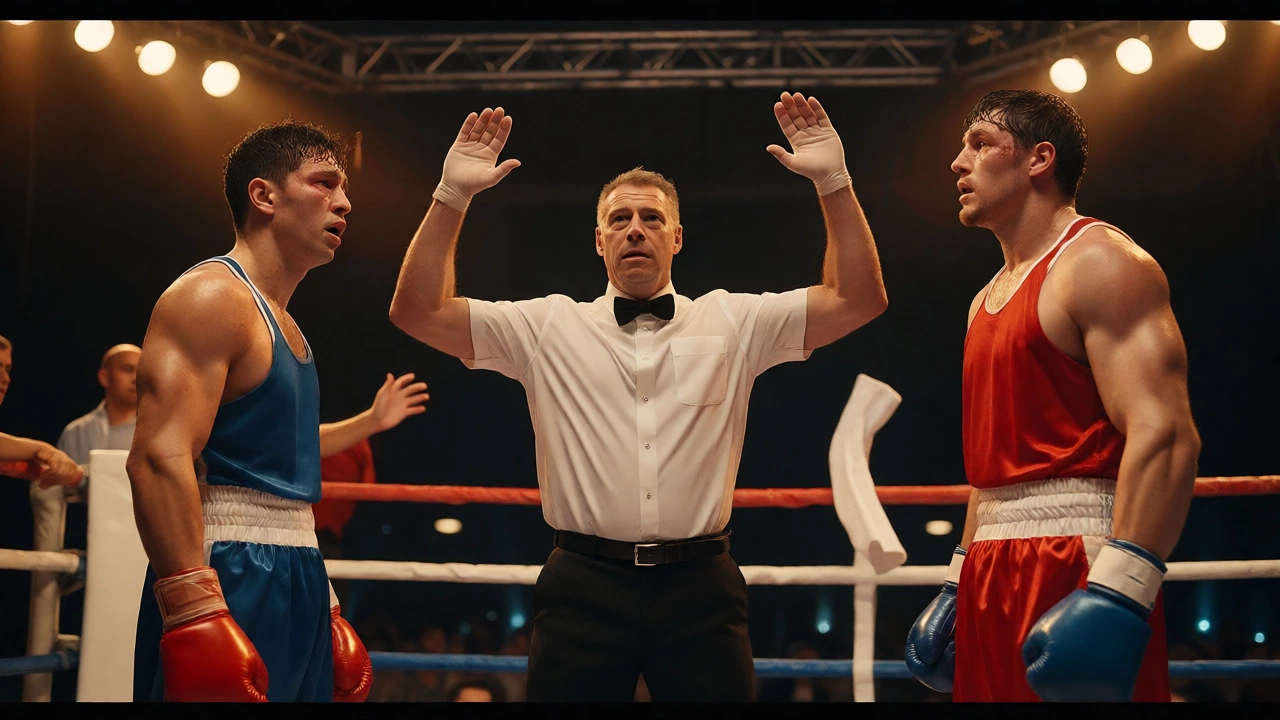
Decisions: When the Judges Decide
Not every fight ends in a finish. Championship bouts often go the full 12 rounds. When the final bell rings, the result is a Decision. Three judges sit ringside, scoring each round based on clean punching, effective aggression, ring generalship, and defense.
Each judge uses the 10-point must system. The winner of a round gets 10 points; the loser usually gets 9. If a fighter gets knocked down, they might lose the round 10-8. At the end, the scores are added up. The fighter with the higher total wins.
But decisions aren’t all equal. Here’s the breakdown:
| Type | Description | Example Score |
|---|---|---|
| Unanimous Decision (UD) | All three judges scored the same winner. | 117-111, 117-111, 116-112 |
| Split Decision (SD) | Two judges favor one fighter, one favors the other. | 114-114, 116-112, 113-115 |
| Majority Decision (MD) | Two judges favor one fighter, one scores it a draw. | 115-113, 115-113, 114-114 |
Split decisions are the ones that start Twitter fights. Remember the Canelo Alvarez vs. Gennady Golovkin rematch? Many fans felt the first fight was a clear win for Canelo, yet it ended in a draw, leading to a rematch. Subjectivity is baked into the sport. There’s no replay review in real-time. You live with the call.
Rare Outcomes: DQ, NC, and Draws
Sometimes, things go wrong outside the normal flow of boxing.
Disqualification (DQ): If a fighter commits a foul-like hitting below the belt, holding excessively, or throwing an illegal elbow-and continues after warnings, they can be disqualified. The opponent wins by DQ. This happened famously when Tyson bit Holyfield’s ear. Holyfield won by DQ.
No Contest (NC): If an accidental clash of heads opens a severe cut early in the fight, making continuation impossible, the bout may be ruled a No Contest. Neither fighter gets a win or a loss. It’s erased from the record books in terms of win-loss stats.
Draw: If the judges’ scores tie, it’s a draw. In title fights, the champion usually keeps the belt unless specific rules state otherwise. Draws are frustrating for fans but rare-ish in modern scoring systems designed to break ties.

Why the Terminology Matters to Fans and Bettors
Knowing the difference between a KO and a TKO isn’t just trivia. It affects betting odds, fighter legacies, and future matchups.
For example, a promoter might hype a fighter as a "KO artist" only if they have a high percentage of KOs. A fighter with many TKOs might be seen as durable but lacking finishing power. Conversely, a fighter who always goes to decisions might be viewed as exciting but lacking killer instinct.
From a health perspective, repeated TKOs due to cuts or fatigue signal durability issues. Repeated KOs signal defensive lapses. Coaches study these patterns to tailor training camps. If your fighter keeps getting TKO’d in the later rounds, you work on conditioning. If they keep getting KO’d in the early rounds, you work on chin protection and counter-punching.
How to Spot the Difference Live
Watching live, it can be hard to distinguish a TKO from a KO in the heat of the moment. Here’s a quick heuristic:
- Did the ref start counting? If yes, and the fighter didn’t stand up, it’s a KO.
- Did the ref wave his hands horizontally? If he stops the fight without starting a count, it’s a TKO.
- Did the corner throw a towel? That’s a Corner TKO.
- Did the fight go past the last bell? Then it’s a decision, regardless of how dominant one side looked.
Context helps. If a fighter is bleeding profusely from a headbutt in round two, and the doctor stops it, that’s a TKO (Doctor Stoppage). If a fighter takes a straight right hand, falls flat on their back, and doesn’t move until the count of ten, that’s a KO.
The Evolution of Stoppages
It’s worth noting that the definition of a TKO has shifted over time. In the 1970s and 80s, referees let fights go much longer. Fighters were expected to "take their medicine." Today, athlete safety is paramount. Referees are trained to stop fights earlier to prevent brain trauma. This means we see fewer long, bloody wars and more decisive TKOs.
Critics argue this softens the sport. Purists miss the days when a fighter could absorb a beating and still win on points. But medical consensus supports earlier stoppages. Chronic Traumatic Encephalopathy (CTE) research has changed how we view concussions. A fighter who is "dazed" is already suffering brain trauma. Waiting for them to collapse might be waiting too long.
Is a TKO the same as a knockout?
No, they are distinct. A Knockout (KO) requires the fighter to be down and unable to rise before the count of ten. A Technical Knockout (TKO) occurs when the referee, corner, or doctor stops the fight because the fighter cannot safely continue, even if they are standing or conscious.
What does UD mean in boxing?
UD stands for Unanimous Decision. It means all three judges scored the fight in favor of the same boxer. It indicates a clear, uncontroversial victory according to the officials.
Can a fight end in a draw?
Yes. If the judges' scorecards result in a tie, the bout is declared a draw. In championship fights, the reigning champion typically retains the title in the event of a draw, unless pre-fight agreements state otherwise.
What is a No Contest?
A No Contest (NC) is a result where neither fighter is declared the winner. This usually happens if an accidental foul, such as a head clash causing a severe cut, makes it impossible to continue the fight early in the bout.
Do knockdowns count towards a TKO?
In some jurisdictions, yes. The "Three Knockdown Rule" states that if a fighter is knocked down three times in a single round, the referee will automatically stop the fight, resulting in a TKO, regardless of whether the fighter recovers.