
What is a Professional Boxing Match Called? Understanding Bout Terminology

Boxing Terminology Quiz
Challenge yourself to master the language of the ring. Select the correct term for each scenario.
Loading question...
Quiz Complete!
You scored 0 out of 5.
You are watching the ring. Two fighters circle each other. The bell rings. You might hear commentators say "fight," "match," or "bout." But if you want to sound like you know what you are talking about when discussing professional boxing a combat sport involving two opponents who attack each other using their fists while wearing protective gloves and following specific rules, you need to know the correct terms. The most common answer to "what is a professional boxing match called?" is simply a bout. However, that word is just the tip of the iceberg. Depending on the stakes, the length, and the outcome, a boxing event has many different names.
This guide breaks down the specific vocabulary used in the boxing world. We will look at why we call it a bout, how it differs from an amateur contest, and what terms describe high-stakes events like championship fights. Whether you are new to the sport or trying to impress friends at the pub, understanding this language helps you appreciate the drama unfolding in the ring.
The Core Term: Why It Is Called a Bout
In professional sports, precision matters. In boxing, the term bout a single contest between two boxers in a professional setting is the standard noun for a match. Unlike "game" or "race," which imply multiple phases or teams, a bout refers specifically to one head-to-head contest. This distinction exists because boxing matches can be part of larger events containing several bouts.
When you buy a ticket to a boxing night, you are not buying into one bout. You are buying into an event card. That card consists of a main event, co-main events, and preliminary bouts. Each individual pairing of fighters is a bout. Using the word "match" isn't wrong in casual conversation, but promoters, judges, and historians prefer "bout" because it emphasizes the isolated nature of the contest. One bout ends; another begins. There is no team score to carry over. It is winner takes all, round by round.
Why does this matter? Because context changes everything. A "sparring session" is not a bout. A "scrimmage" is not a bout. A bout requires a referee, a timekeeper, and official scoring. If you are writing a report or discussing results with serious fans, use "bout." It signals that you understand the formal structure of the sport.
Amateur vs. Professional: Different Names for Different Rules
Not every fistfight in a ring is a professional bout. The name changes based on the rule set. Amateur boxing the form of boxing governed by the International Boxing Association (IBA) where participants wear headgear and scoring is often computer-assisted uses different terminology. In the Olympics or national championships, these contests are still technically bouts, but they are often referred to as "contests" or "bouts" within a tournament bracket.
The key difference lies in the objective. Amateur boxing focuses on accumulating points through clean hits. Professional boxing focuses on dominance, entertainment, and often knockouts. Because of this, professional bouts have specific sub-categories based on their significance. Calling an Olympic gold medal fight a "pro bout" would be factually incorrect. Calling a local club show fight a "title fight" would be misleading. Knowing the hierarchy prevents confusion.
| Term | Context | Stakes | Typical Duration |
|---|---|---|---|
| Bout | General professional match | Low to Medium | 4-10 Rounds |
| Title Fight | Championship bout | High (Belts) | 12 Rounds |
| Scrimmage | Training exercise | None | Variable |
| Exhibition | Non-competitive display | Prestige only | 3-8 Rounds |
The Hierarchy of Bouts: From Prelims to Main Events
When you watch a televised boxing night, you see a lineup. This lineup is structured by importance. Understanding these tiers helps you identify what kind of bout you are watching.
- Preliminary Bouts: These are the first fights of the night. They usually feature up-and-coming fighters or those rebuilding their records. They are shorter, typically four to six rounds. Fans often leave before these end, but they are crucial for developing talent.
- Co-Main Event: This is the second most important bout on the card. It often features high-profile fighters who didn't quite make the top slot, or a highly anticipated matchup that serves as a lead-in to the main event.
- Main Event: This is the headline bout. It features the biggest stars, the highest paydays, and often the championship belts. When people ask "who won tonight's fight?", they are almost always referring to the main event bout.
There is also the concept of the undercard the series of preliminary bouts held before the main event of a boxing promotion. This includes all the bouts preceding the co-main event. While less glamorous, undercard bouts are where future champions are discovered. If you attend a live event, staying for the undercard offers better value and closer views than the expensive seats reserved for the main event crowd.

Specialized Terms: Title Fights, Rematches, and Superfights
As a bout gains prestige, its name evolves. A standard professional bout becomes a title fight a bout where a championship belt is on the line when a major organization sanctions it. The four major sanctioning bodies-the WBC, WBA, IBF, and WBO-govern these bouts. If a fighter wins a title fight, they become the champion. If they lose, they are stripped of the title.
What happens when two champions fight each other? That is a unification bout. The winner holds multiple belts. If the fighters come from different weight classes or organizations and agree to fight despite no immediate title unification, it might be called a superfight. This term implies exceptional star power rather than administrative necessity.
Then there is the rematch. Boxing loves a sequel. If Fighter A beats Fighter B, they may schedule a rematch. Sometimes, a third fight occurs, known as a trilogy bout. The famous Ali-Frazier trilogy is the classic example. Each of those was a separate bout, but together they form a historic narrative. Always check if a fight is a first meeting or a rematch, as the psychological dynamic changes completely.
Outcomes: How Bouts End and What They Are Called
The way a bout ends dictates its classification. You cannot just say "he won." You must specify how.
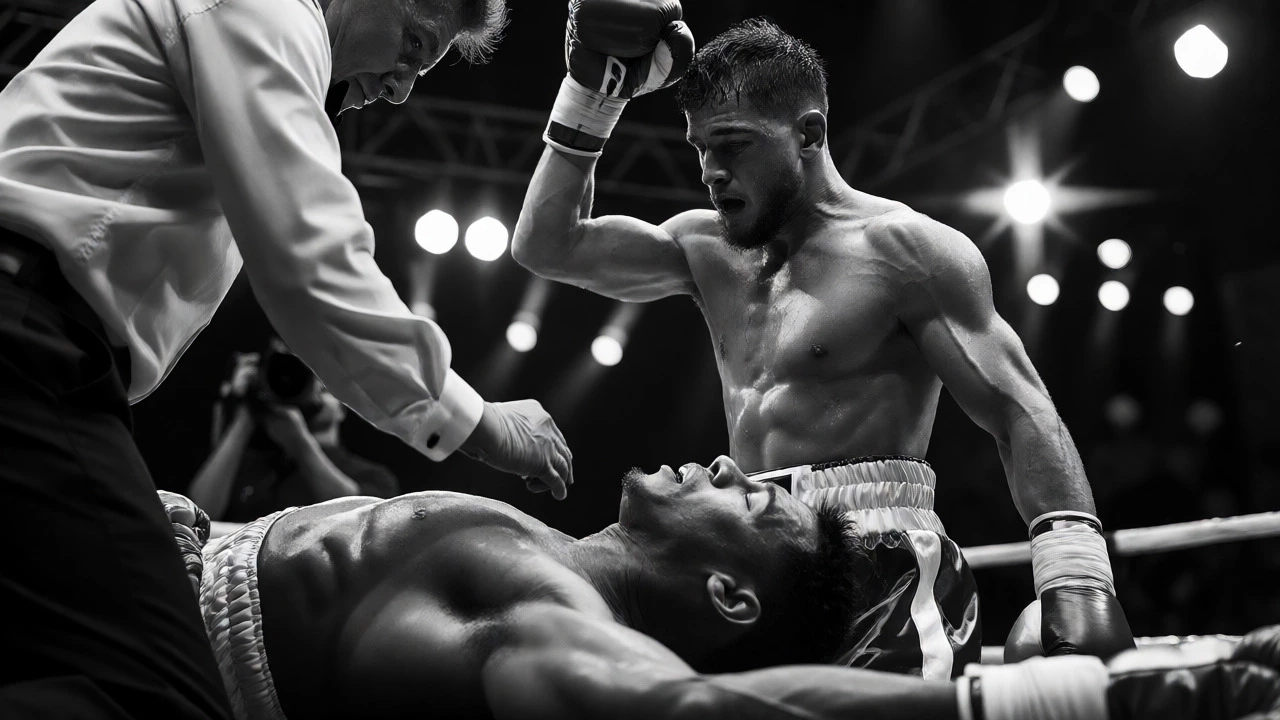
- KO (Knockout): The fighter is knocked down and cannot rise before the ten-count. This is the most decisive end to a bout.
- TKO (Technical Knockout): The referee stops the fight because a fighter is taking too much punishment, even if they haven't been knocked down. Or, the corner throws in the towel.
- Decision: The bout goes the distance. Judges score the rounds. This can be a Unanimous Decision (all judges agree), Split Decision (two judges favor one, one favors the other), or Majority Draw.
- No Contest (NC): Something illegal happens, like a low blow that causes a stoppage without enough rounds completed. The bout result is erased.
Understanding these outcomes is vital for interpreting records. A fighter with 20 wins and 5 KOs looks very different from a fighter with 20 wins and 20 decisions. The former is a finisher; the latter is a technician. The type of bout conclusion tells you about the fighter's style and durability.
Common Misconceptions About Boxing Terminology
Many newcomers confuse rounds with bouts. A bout consists of multiple rounds. A round is three minutes of fighting followed by one minute of rest. Professional men's bouts are typically scheduled for 10 or 12 rounds. Women's bouts were historically limited to 10 rounds but have increasingly moved to 12-round formats in recent years.
Another confusion is between a sparring session and a bout. Sparring is practice. Fighters wear headgear, hit with controlled force, and do not keep official scores. A bout is competitive. Mistaking sparring footage for actual fight footage leads to misjudging a fighter's real-world capability. Always look for the referee and the official scoreboard to confirm it is a bout.
Finally, do not confuse a showcase with a main event. Promoters sometimes label a mid-card fight as a "showcase" to hype it up. Unless a title is on the line or it is the last fight of the night, it is rarely the true main event. Check the official press release or the promotional poster for the actual bout order.
Key Takeaways
- The standard term for a professional boxing match is a bout.
- A title fight is a bout where a championship belt is at stake.
- The undercard consists of preliminary bouts before the main event.
- Bouts end via KO, TKO, Decision, or No Contest, each carrying different implications for a fighter's record.
- Amateur contests differ from professional bouts in rules, duration, and scoring methods.
Is a boxing match the same as a bout?
Yes, in casual conversation, they are interchangeable. However, in official boxing contexts, "bout" is the preferred technical term for a single contest between two fighters. "Match" can sometimes refer to the entire event card containing multiple bouts.
How many rounds are in a professional boxing bout?
Most non-title professional bouts are scheduled for 4, 6, or 8 rounds. Championship title fights are typically scheduled for 12 rounds. Some regional titles may be 10 rounds. The number depends on the fighters' experience levels and the governing body's regulations.
What is the difference between a bout and a sparring session?
A bout is a competitive, scored contest with a referee enforcing rules for a win-loss record. A sparring session is a training exercise where fighters practice techniques without necessarily aiming for a knockout or official score. Sparring often involves headgear and controlled intensity.
What does 'No Contest' mean in a boxing bout?
A 'No Contest' means the bout result is annulled. This usually happens if an accidental foul, such as a low blow, stops the fight before a certain number of rounds are completed, or if a fighter fails a post-fight drug test. Neither fighter gets a win or a loss on their record.
Are women's boxing bouts shorter than men's?
Historically, yes. Many commissions capped women's bouts at 10 rounds. However, this has changed significantly. Major promotions now regularly sanction 12-round title fights for women, aligning them with the men's format for maximum competitiveness and viewer engagement.