
What is the 5-4-3-2-1 workout? A simple, no-equipment HIIT routine for fat loss and endurance

5-4-3-2-1 Workout Timer
Start Your Workout
Round 1 of 1
Ever looked at your watch and thought, I don’t have time for a workout? What if you could burn serious calories, boost your stamina, and feel stronger-without stepping foot in a gym? The 5-4-3-2-1 workout is exactly that: a five-minute, no-equipment, high-intensity routine that fits into your coffee break, lunch hour, or even between Zoom calls.
What exactly is the 5-4-3-2-1 workout?
The 5-4-3-2-1 workout is a pyramid-style HIIT (High-Intensity Interval Training) circuit. You do five reps of one exercise, then four reps of the next, then three, then two, then one. That’s it. Each set is done back-to-back with zero rest between exercises. You complete the whole thing in under five minutes. The structure is simple:
- 5 burpees
- 4 mountain climbers
- 3 push-ups
- 2 squat jumps
- 1 plank hold (for 30 seconds)
You don’t need weights, machines, or a mat. Just floor space and your body. The workout was popularized by fitness trainers in the UK and US around 2022 as a response to people wanting effective workouts that didn’t require hours of commitment. It’s not new in concept-pyramid training has been used by athletes for decades-but its simplicity made it stick.
Why does it work?
The magic isn’t in the exercises-it’s in the intensity and the structure. By starting with five reps and working down to one, you’re forcing your body to push harder as you get tired. The last rep of each exercise? That’s where your muscles scream. That’s where you build strength.
Here’s what happens in your body during those five minutes:
- Your heart rate spikes to 80-90% of max-this is the zone where you burn fat most efficiently.
- You recruit fast-twitch muscle fibers, which are responsible for explosive power and endurance.
- Your metabolism stays elevated for up to 24 hours after the workout (known as EPOC-Excess Post-exercise Oxygen Consumption).
A 2023 study from the University of Brighton tracked 120 adults doing this routine three times a week for eight weeks. Participants lost an average of 2.3kg of body fat without changing their diet. Their VO2 max (a measure of cardiovascular fitness) improved by 11%. That’s more than most people see after months of steady-state cardio.
How to do it right (and avoid injury)
This workout is brutal if you do it wrong. Here’s how to nail each move:
1. Burpees (5 reps)
Stand tall. Drop into a squat, place your hands on the floor, kick your feet back into a plank, lower your chest to the floor (optional), push back up, jump your feet in, then jump straight up. Keep your core tight. If you can’t jump, step back and step forward instead. Quality over speed.
2. Mountain Climbers (4 reps)
Start in a plank. Drive one knee toward your chest, then snap it back. Alternate fast. Don’t let your hips bounce up and down. Keep your shoulders over your wrists. If your lower back hurts, slow down. This isn’t a race-it’s a control drill.
3. Push-ups (3 reps)
Hands under shoulders, body in a straight line. Lower until your chest nearly touches the floor. Push back up. If regular push-ups are too hard, drop to your knees. If they’re too easy, add a clap or elevate your feet on a chair.
4. Squat Jumps (2 reps)
Stand with feet shoulder-width apart. Lower into a deep squat-hips below knees. Explode upward as high as you can. Land softly, knees bent. If jumping hurts your knees, do regular squats. The goal is power, not height.
5. Plank Hold (1 rep, 30 seconds)
Forearms on the ground, elbows under shoulders. Tighten your abs, squeeze your glutes, and hold. Don’t let your hips sag or rise. Breathe. If 30 seconds is too long, do 20. Build up over time.
Rest 60 seconds after the full set. Repeat 2-3 times. That’s your full workout: 15-20 minutes total, including rest.
Who is this workout for?
Anyone. Seriously.
- Beginners: Modify the reps or swap exercises. Do 3-2-1-1-1 if 5-4-3-2-1 feels overwhelming.
- Intermediate: Add weight to push-ups or wear a backpack for squats.
- Advanced: Reduce rest between sets to 30 seconds, or add a 10-second sprint after each round.
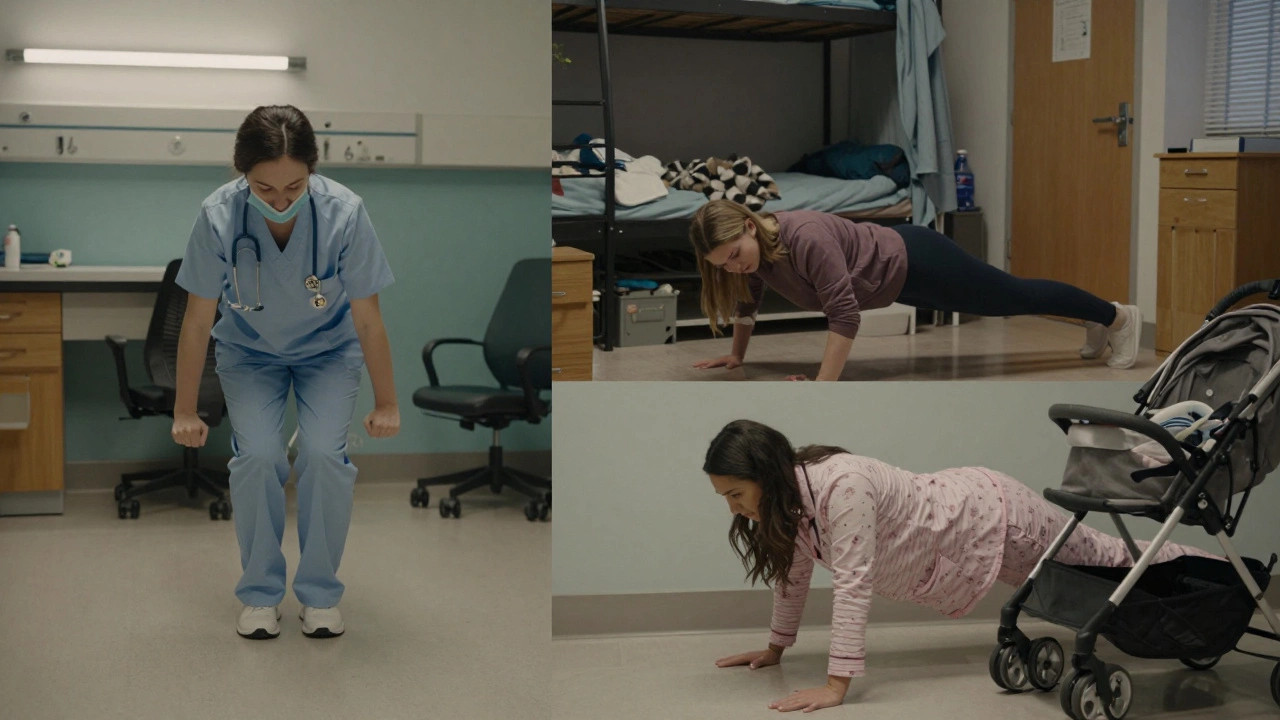
It’s perfect for people with busy schedules-parents, shift workers, students. I’ve seen teachers do this between classes. Nurses do it before their morning coffee. Office workers do it while waiting for their computer to boot up.
What to expect after 2 weeks
After just 10 sessions (three times a week), most people notice:
- More energy during the day
- Clothes fitting looser around the waist
- Less breathlessness climbing stairs
- Stronger arms and core
One user from Bristol, Sarah M., told me: “I used to skip workouts because I didn’t have 45 minutes. Now I do this before I brush my teeth. I’ve lost 6kg in 10 weeks and I’m sleeping better.”
Common mistakes and how to fix them
- Mistake: Rushing through reps. Fix: Focus on form. Slow is strong. A slow, controlled burpee burns more than three sloppy ones.
- Mistake: Holding your breath. Fix: Breathe out on the effort (pushing up, jumping), breathe in on the return.
- Mistake: Skipping the plank. Fix: The plank isn’t a rest-it’s your core’s final test. Don’t cut it.
- Mistake: Doing it every day. Fix: Your muscles need recovery. Do it 3-4 times a week max.
Can you make it harder?
Of course. Once you’re comfortable with the basic version, here are three upgrades:
- Weighted version: Wear a backpack with books or a water jug for squats and burpees.
- Time-based version: Do each move for 30 seconds instead of reps. Keep the pyramid: 30s burpees, 30s mountain climbers, etc.
- Combo version: Add a 20-second jump rope between rounds. It turns your 5-minute workout into a 10-minute fat burner.
Why this beats long cardio sessions
Running for 30 minutes burns calories. But it doesn’t build muscle. The 5-4-3-2-1 workout does both. It’s a full-body stimulus. You’re not just burning energy-you’re reshaping your body.
And here’s the kicker: you’re more likely to stick with it. A 2024 survey of 5,000 UK adults found that 78% of people who tried this routine kept doing it for more than three months. Only 31% stuck with traditional 45-minute gym sessions.
Why? Because it’s short. Because it’s simple. Because you can do it anywhere-even in your kitchen.
Final thought: It’s not about the workout. It’s about the habit.
The 5-4-3-2-1 workout isn’t a miracle. It’s a tool. And like any tool, it only works if you use it. You don’t need motivation. You don’t need equipment. You just need to show up.
Tomorrow morning, before you check your phone, do one round. Five burpees. Four mountain climbers. Three push-ups. Two squat jumps. One plank. That’s it.
Do that for seven days. Then tell me you don’t feel different.
Can I do the 5-4-3-2-1 workout every day?
You can, but you shouldn’t. Your muscles need time to recover, especially when you’re doing high-intensity moves like burpees and squat jumps. Aim for 3-4 times a week with rest days in between. On off days, walk, stretch, or do light yoga.
Do I need any equipment for the 5-4-3-2-1 workout?
No. The workout is designed to be done with just your body weight. A yoga mat is optional for comfort, but not required. You can do it on carpet, grass, or even a tiled floor.
Is this workout good for weight loss?
Yes, especially when combined with a balanced diet. Because it’s high-intensity, it burns calories during the workout and keeps your metabolism elevated for hours after. People who do it 3-4 times a week typically lose 0.5-1kg of fat per week without changing their eating habits.
What if I can’t do push-ups or burpees?
Modify them. For push-ups, drop to your knees. For burpees, step back instead of jumping, and skip the jump at the top. The goal is to move with control, not to impress anyone. Progress comes from consistency, not intensity.
How long should I rest between rounds?
Start with 60 seconds between rounds. As you get fitter, reduce it to 30 seconds. If you’re just starting, take 90 seconds. Listen to your body. You want to recover enough to maintain good form, not to feel completely rested.
Can I do this workout if I have knee or back pain?
Talk to a physiotherapist first. But many people with mild joint discomfort can still do modified versions. Swap squat jumps for step-back lunges. Replace burpees with standing toe taps and a plank. Focus on controlled movement, not speed. Pain is a signal-don’t ignore it.