
Which Workout Hits Which Muscle? A Simple Guide to Targeting Every Body Part
Muscle Targeting Calculator
Which Muscle Does Your Exercise Target?
Enter any common exercise to see which muscles it activates and how to optimize your form.
Ever done a set of push-ups and wondered why your shoulders burn more than your chest? Or hit squats only to feel it in your lower back instead of your quads? You’re not alone. Most people guess which muscles they’re working - and end up missing the point entirely. The truth is, every exercise has a primary target, but it also wakes up a whole team of helper muscles. Knowing exactly which workout hits which muscle isn’t just about looking good - it’s about building real strength, avoiding injury, and getting the most out of every minute you spend in the gym.
Push-Ups: Chest, Shoulders, and Triceps - But Not Equal
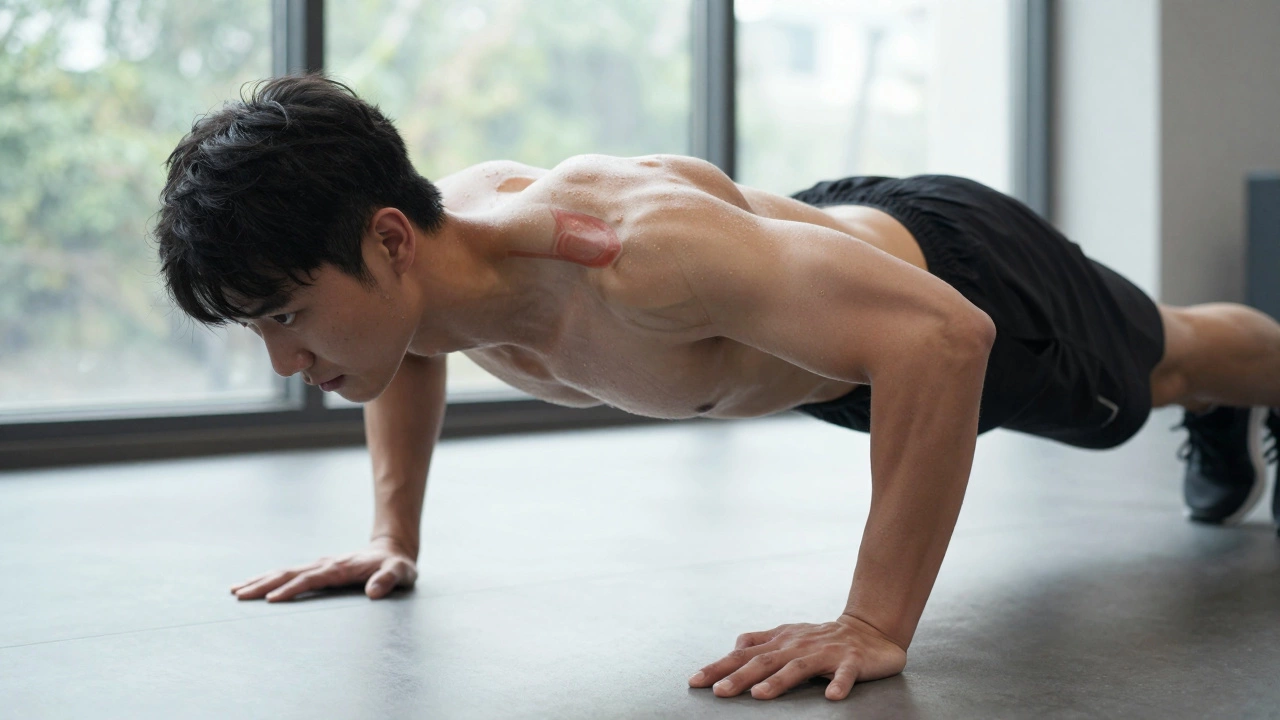
Push-ups look simple. Lie down, push up, done. But here’s what most people get wrong: if you’re doing them with your elbows flaring out and your body sagging, you’re not really hitting your chest. You’re overworking your shoulders and straining your lower back.
When done right - hands slightly wider than shoulder-width, body tight like a plank, elbows at 45 degrees - push-ups activate your pectoralis major (main chest muscle) as the leader. Your anterior deltoids (front shoulders) and triceps brachii (back of the arm) jump in as secondary movers. Your core? It’s holding everything together. No one talks about it, but your rectus abdominis and obliques are working harder than you think to keep your hips from dropping.
Try this: slow down your push-up. Take three seconds down, pause at the bottom, then push up hard. You’ll feel your chest fire up like never before.
Squats: Quads Lead, Glutes Finish
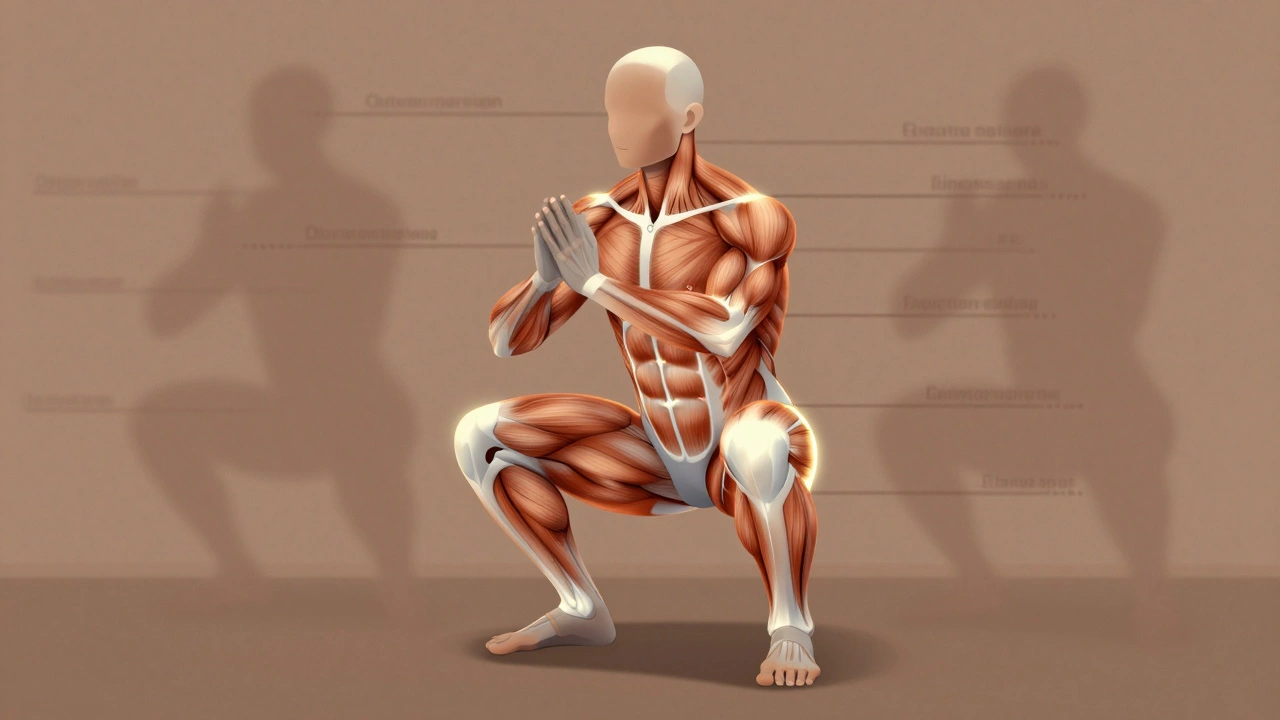
Squats are the king of lower body lifts - but only if you’re doing them right. Too many people think squats are just for glutes. They’re not. The real hero here is your quadriceps - the big muscle group on the front of your thighs. They do the heavy lifting as you lower and rise.
Your gluteus maximus kicks in hardest when you drive up from the bottom. That’s why deep squats (thighs parallel or below parallel) are better than shallow ones. Your hamstrings help stabilize, and your erector spinae (lower back muscles) hold your spine upright. If your lower back aches more than your legs, your form is off.
Pro tip: push through your heels, not your toes. Keep your chest up, knees tracking over your second toes. If you can’t get your hips below knee level without rounding your back, work on mobility before adding weight.
Deadlifts: Back, Hips, and Grip - The Full Package
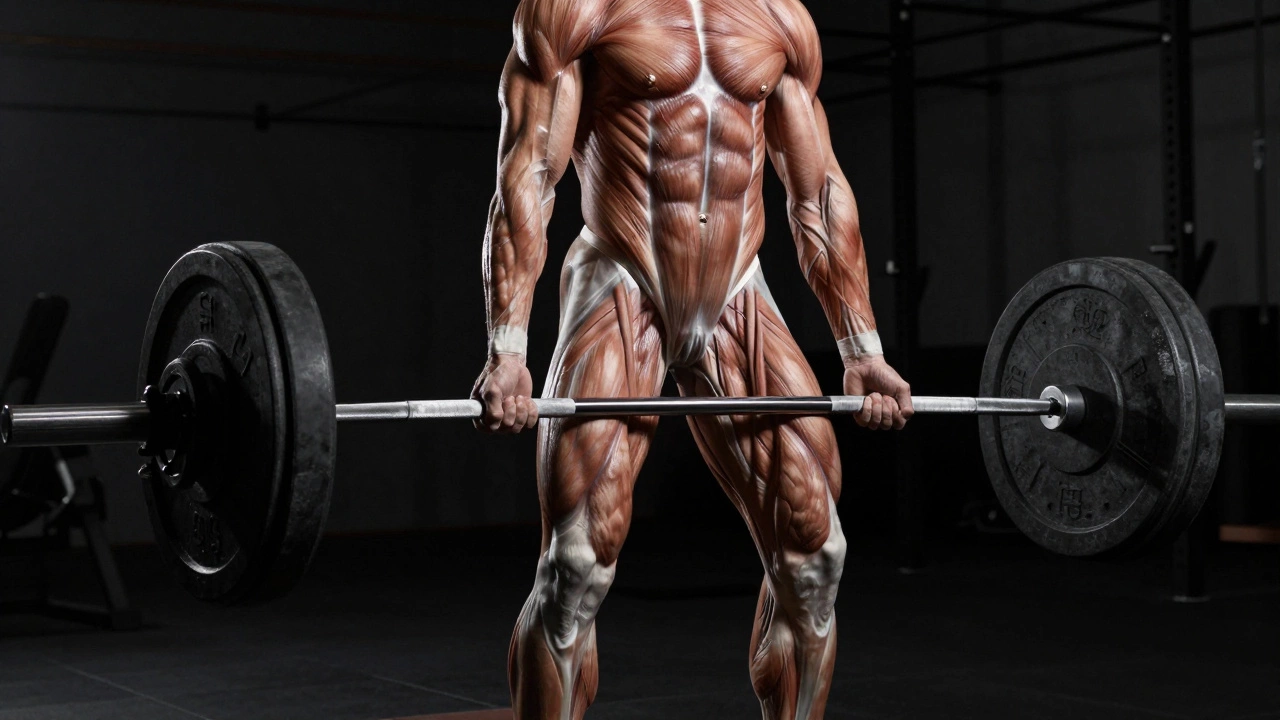
Deadlifts don’t just build a strong back - they build a strong person. This lift hits more muscles than almost any other. Your latissimus dorsi (lats) pull the bar up your legs. Your trapezius (upper back) shrugs the weight into position. Your glutes and hamstrings extend your hips. Your forearms and hand muscles are taxed just holding the bar.
Here’s the catch: if you’re feeling this in your lower back, you’re not using your hips. The deadlift isn’t a back exercise - it’s a hip hinge. Think of it like opening a door with your hips, not lifting with your spine. Your back stays rigid, not bent.
Try this: before you lift, take a deep breath, brace your core like you’re about to get punched, and pull the slack out of the bar. Then drive through your heels. If your shoulders move before your hips, you’re doing it wrong.
Bench Press: Chest, Triceps, and Shoulders - The Trio
The bench press is the classic chest builder - but it’s not just about the chest. Your pectoralis major does about 60% of the work. The rest? Split between your triceps (pushing the weight up) and anterior deltoids (holding the bar steady).
Here’s where people mess up: flaring elbows wide. That puts insane pressure on your shoulder joint. Keep elbows at 45 degrees to your torso. That shifts the load back to your chest and protects your shoulders.
Also, don’t arch your back too much. A slight natural curve is fine. A full bridge? That’s not strength - that’s cheating. Your glutes and lats should be tight, not lifting you off the bench.
Want to target chest more? Try a slight incline. Want to focus on triceps? Go narrow grip. The angle changes everything.
Rows: Back, Biceps, and Stability
Rows are the unsung hero of back training. People do curls for biceps and pull-ups for lats - but rows? They’re the glue. Whether you’re doing barbell rows, dumbbell rows, or cable rows, your latissimus dorsi is the main mover. Your rhomboids (between shoulder blades) squeeze to retract your scapulae. Your biceps brachii help pull the weight in.
But here’s the secret: if you’re not squeezing your shoulder blades together at the top, you’re not working your back. You’re just moving weight. The goal isn’t to lift heavy - it’s to feel your back contract.
Try this: pause for one second at the top of each rep. Squeeze like you’re trying to hold a pencil between your shoulder blades. Then lower slowly. You’ll feel it in places you didn’t know existed.
Planks: Core Isn’t Just Abs
Most people think planks are for six-pack abs. They’re not. Your rectus abdominis (the ‘six-pack’ muscle) does a little. But your real stars are your transverse abdominis (deep core stabilizer), your obliques, and your erector spinae. Even your glutes and quads are firing to keep your body straight.
If your hips sag or your butt sticks up, you’re not engaging your core. You’re just holding a position. That’s why 30-second planks with perfect form beat 2-minute planks with bad posture.
Want to make it harder? Try a plank with shoulder taps. Or a side plank. That shifts the focus to your obliques and hips.
Pull-Ups: Lats, Biceps, and Grip - The Ultimate Test
Pull-ups are the gold standard for upper body strength. Your latissimus dorsi pulls your body up. Your biceps help bend your elbows. Your forearms grip the bar. Your core keeps your legs from swinging. Your traps and rhomboids stabilize your shoulder blades.
Too many people swing or use momentum. That turns a strength test into a cardio trick. If you can’t do a strict pull-up, start with negatives: jump up, then lower yourself slowly for 5 seconds. That builds real strength.
Wider grip? More lat focus. Narrow grip? More biceps. Chin-ups (palms facing you) hit the biceps harder. Try them all.
Why Knowing This Matters
When you know which muscle each workout hits, you stop guessing. You stop doing 10 exercises that all feel the same. You start building balanced strength. That means fewer injuries. Better posture. More progress.
Think of your body like a car. If you only ever drive in first gear, you’ll wear out the engine. If you only train your chest and arms, you’ll get imbalances. Your shoulders will hunch. Your back will ache. Your hips will tighten.
Balance is everything. Train push and pull. Train upper and lower. Train front and back. That’s how you build a body that works - not just one that looks good.
Quick Reference: Muscle Groups and Top Exercises
- Chest: Bench press, push-ups, dumbbell flyes
- Back: Deadlifts, pull-ups, barbell rows, lat pulldowns
- Shoulders: Overhead press, lateral raises, front raises
- Triceps: Close-grip bench press, dips, skull crushers
- Biceps: Pull-ups, chin-ups, dumbbell curls, barbell curls
- Quads: Squats, lunges, leg press
- Glutes: Hip thrusts, Romanian deadlifts, step-ups
- Hamstrings: Deadlifts, leg curls, glute-ham raises
- Core: Planks, hanging leg raises, Russian twists, ab wheel rollouts
Frequently Asked Questions
Can one exercise target multiple muscles at once?
Yes - and that’s actually the goal. Compound lifts like squats, deadlifts, and pull-ups work multiple muscle groups together. That’s why they’re so effective. A squat doesn’t just hit your quads - it engages your glutes, hamstrings, core, and even your upper back to keep your posture stable. These multi-joint movements build real strength faster than isolation exercises.
Why do I feel it in my lower back during squats?
If your lower back hurts during squats, you’re likely rounding your spine or letting your hips rise faster than your chest. That shifts the load from your legs to your spine. Fix it by bracing your core, keeping your chest up, and only going as deep as you can while maintaining a neutral spine. Mobility work for your hips and ankles can also help.
Should I do isolation exercises or compound lifts first?
Always start with compound lifts. They require the most energy, coordination, and focus. Do squats, deadlifts, bench presses, and rows before moving to bicep curls or leg extensions. Isolation moves are great for fine-tuning, but they’re not your foundation. Save them for the end of your workout.
How do I know if I’m using the right muscle?
Pay attention to where you feel the burn. If you’re doing a row and feel it in your biceps more than your back, you’re pulling with your arms instead of squeezing your shoulder blades. Slow down. Focus on the movement, not the weight. Record yourself. Ask someone to check your form. Muscle awareness comes with practice - not just repetition.
Can I build muscle without equipment?
Absolutely. Bodyweight exercises like push-ups, squats, lunges, and pull-ups (if you have a bar) can build serious strength. The key is progression: make them harder over time. Do more reps. Slow down the movement. Add pauses. Try single-leg variations. You don’t need a gym - you need consistency and smart progression.