
What Is a 9 in Boxing? Understanding the Scoring System
Boxing Scorecard Simulator
Fight Settings
Fighter A
Fighter B
Imagine watching a brutal twelve-round war. The bell rings for the final time, and both fighters are standing, battered but defiant. You look at the scorecards on your screen or hear the announcer read them out: "Ten-nine, ten-nine, ten-nine." It sounds like a clear win, right? But if you’ve ever watched a controversial decision, you know that a single '9' can change everything. In fact, one judge giving a round a 9-8 instead of a 10-8 can flip the entire result of a championship bout.
If you’re new to the sport, seeing those numbers might feel arbitrary. Why not just count punches? Why is a '9' such a big deal? To understand what a 9 means in boxing, we have to look under the hood of the 10-point must system, which is the standard scoring method used globally in professional boxing where the winner of each round receives 10 points and the loser receives 9 or fewer. This system isn't just about math; it's about interpreting violence, strategy, and dominance through the eyes of three human observers.
The Basics of the 10-Point Must System
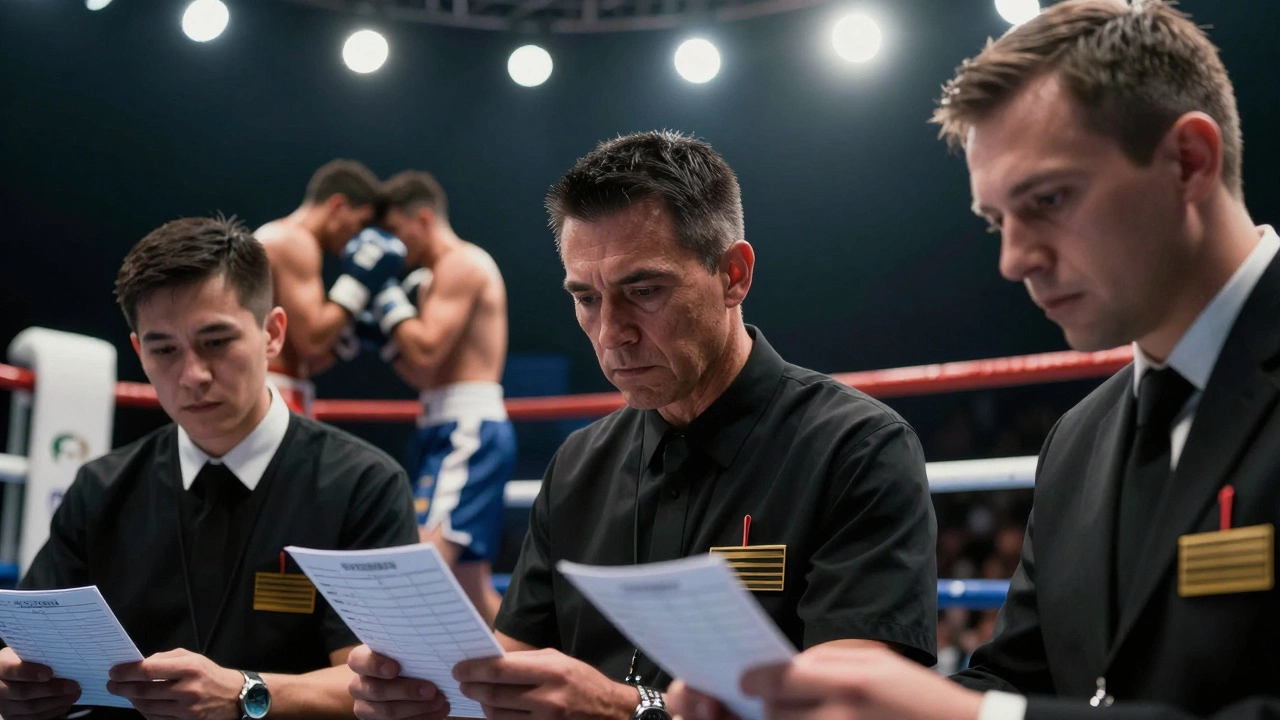
Before we get into the specifics of the '9', you need to understand the baseline. In professional boxing, every round is scored individually by three judges sitting ringside. At the end of each two-minute (or sometimes three-minute) period, each judge must declare a winner of that specific round.
The winner of the round automatically gets 10 points. That part never changes. The question is always: how many points does the loser get?
- 10-9: This is the most common score. It means one fighter clearly won the round. They landed more significant punches, controlled the distance, or showed better ring generalship. It’s a comfortable victory for that minute of action.
- 10-8: This is a dominant round. One fighter was completely overwhelming the other-perhaps with a sustained flurry, a knockdown, or total control while the opponent offered zero offense. This is rare in high-level fights.
- 10-7: Extremely rare. This usually requires multiple knockdowns in a single round without any meaningful counter-punching from the victim.
- 10-10: A draw for that round. Both fighters performed equally well. This is also uncommon because judges are instructed to pick a winner whenever possible.
So, when you see a '9', it simply means the losing fighter had a decent round. They weren't destroyed. They were active, they landed some shots, and they defended reasonably well. They just didn't do enough to take the round away from their opponent.
What Exactly Triggers a 9?
You might wonder, "How close does it have to be to give a 9?" There is no strict mathematical formula. Judges don't have stopwatches or punch counters in their hands. Instead, they rely on four main criteria defined by boxing commissions worldwide:
- Clean Punching: Who landed the harder, cleaner shots? Glancing blows don't count much. Judges look for punches that connect flush with the head or body.
- Effective Aggression: Moving forward and attacking counts, but only if you're landing. Walking into fire and getting hit repeatedly is not effective aggression; it's just being aggressive.
- Ring Generalship: Who was controlling the pace and position? Did one fighter trap the other against the ropes? Did one fighter make the other miss repeatedly?
- Defense: Slipping punches, blocking hooks, and maintaining guard structure matters. If Fighter A throws ten punches but Fighter B slips all of them and lands one sharp counter, Fighter B might win the round 10-9 despite throwing fewer punches.
A '9' is awarded when the difference between these factors is noticeable but not overwhelming. For example, if Fighter A lands three solid jabs and Fighter B lands two solid crosses, Fighter A likely wins the round 10-9. The gap is small. Both fighters were doing damage, but A did slightly more.
The Power of the 10-8 Round
To truly appreciate the '9', you have to understand its opposite: the 10-8. In a twelve-round fight, the maximum possible point spread is 120-108. However, most competitive fights end with scores like 115-113 or 114-114.
Here is why the '9' is so critical: a single 10-8 round can erase two 10-9 losses.
Let’s break that down with simple math. Imagine a six-round bout. Fighter A wins rounds 1, 2, and 6 (10-9 each). Fighter B wins rounds 3, 4, and 5. If Fighter B wins rounds 3 and 4 decisively (10-8), and round 5 narrowly (10-9), here is the score: Round 1: A 10 - B 9 Round 2: A 10 - B 9 Round 3: A 8 - B 10 (Dominant) Round 4: A 8 - B 10 (Dominant) Round 5: A 9 - B 10 (Narrow) Round 6: A 10 - B 9 Total Score: Fighter A: 47 Fighter B: 48 Fighter B wins the fight! Even though Fighter A won three rounds to B's three, the *quality* of B's victories mattered more. Those two 10-8 rounds gave B a two-point cushion that allowed him to lose a round narrowly and still come out on top. This is why fighters often say, "You can't just win rounds; you have to dominate them."
Why Do Controversial Decisions Happen?
We’ve all seen them. A fighter looks like he lost badly, yet the judges score it a split decision in his favor. Or a fighter who was knocked down twice wins on points. These moments usually boil down to how different judges value the '9' versus the '10-8'.
Judges have different biases. Some judges favor volume punching-they see a lot of movement and activity and score it 10-9, even if the punches aren't landing cleanly. Other judges favor power and impact-they will give a 10-8 to a fighter who lands one huge shot, even if they were passive for the rest of the round.
Consider the famous case of Floyd Mayweather vs. Manny Pacquiao in 2015. All three judges scored the fight 118-110 in favor of Mayweather. Many casual viewers thought Pacquiao won several rounds. Why the discrepancy? Mayweather’s defense was so elite that he rarely took clean shots. To a judge prioritizing "clean punching," Mayweather won almost every round 10-9 because Pacquiao’s punches were slipping off his gloves. To a fan watching from home, Pacquiao looked more active. But activity doesn't equal points. If the punch doesn't land, it’s worth zero. This disconnect between what the eye sees (activity) and what the rulebook rewards (impact) is the root of most scoring debates.
Knockdowns and Their Impact on Scoring
There is a common misconception that a knockdown automatically results in a 10-8 round. This is not true. A knockdown adds a point deduction to the loser, effectively making the round 10-8 if it would have otherwise been 10-9.
Here is how it works logically: 1. Judge determines the winner of the round based on action. Let’s say Fighter A wins the round normally. That’s 10-9. 2. Fighter B gets knocked down once during that round. 3. The rule states a knockdown deducts one point from the fallen fighter. 4. So, 9 becomes 8. The round is now scored 10-8. However, if Fighter B was dominating the round until the very last ten seconds and then slipped and fell, a judge might still score it 10-9 for Fighter B, and then deduct the point for the knockdown, resulting in a 10-8 for Fighter A. Wait-that’s confusing. Let’s simplify.
In practice, if a fighter is knocked down, the round almost always ends up 10-8 unless the other fighter was completely inactive before the fall. But here is the nuance: if a fighter is knocked down *twice* in a round, it typically results in a 10-7 score (10-9 base + 2 deductions). This is a massive swing in momentum and points.
| Score | Description | Frequency |
|---|---|---|
| 10-9 | Clear winner. More clean punches, better control. | Very Common |
| 10-8 | Dominant performance. One-sided action or a knockdown. | Occasional |
| 10-10 | Evenly matched. Neither fighter established an edge. | Rare |
| 10-7 | Total domination. Usually involves two knockdowns. | Very Rare |
How to Score Like a Judge
If you want to move beyond guessing and start understanding the logic behind the cards, try this exercise next time you watch a fight. Don’t watch the whole round as a blur. Break it into three thirty-second segments.
Ask yourself these questions after each segment: - Who landed the hardest shot? - Who made the other person miss? - Who was dictating the speed? At the end of the round, tally your mental notes. If Fighter A had two great flurries and Fighter B had one good counter, Fighter A likely takes it 10-9. If Fighter A had two great flurries and Fighter B stood there taking punishment with no answer, Fighter A takes it 10-8.
Remember, boxing is a game of inches and ounces. A '9' is not a failure. It is an acknowledgment that the fighter competed well but fell just short of superiority. In a sport where championships are often decided by a single point across three scorecards, that '9' is the difference between glory and heartbreak.
Can a round be scored 9-9?
No. Under the 10-point must system, the winner of the round must receive 10 points. Therefore, the lowest possible score for the winner is 10, and the highest for the loser is 9 (in a non-dominant round). A 9-9 score is impossible in professional boxing scoring.
Does a knockdown always mean a 10-8 round?
Almost always, but technically no. A knockdown deducts one point from the loser. If a judge believes the round was evenly fought (10-10) before the knockdown, it would become 10-9. However, judges rarely score rounds 10-10. Most commonly, a knockdown turns a 10-9 round into a 10-8 round.
Who decides the official scorecards?
Three independent judges seated at ringside decide the scorecards. Each judge keeps their own card privately. After the final bell, the cards are collected and compared. If two judges agree on a winner, that is the result. If all three disagree (a triple split), the result is a draw.
Why do some judges score fights differently than fans?
Judges focus on "clean punching" and "effective aggression," while fans often react to activity, noise, and drama. A fighter might throw 50 punches but land none, while another throws 5 punches and lands all of them sharply. Fans may prefer the active fighter, but judges will score the round for the one who actually connected.
What happens if a fight ends in a draw?
If the total points are equal across all three judges, it is a majority or unanimous draw. If the judges' cards conflict (e.g., two judges say Fighter A won, one says Fighter B won, and one says Draw), it is a split draw. In title fights, draws often lead to rematches, but the champion usually retains the belt unless the commission rules otherwise.