
Why Does Rugby Go Over 80 Minutes?

Rugby Match Time Calculator
Calculate your match duration based on stoppage time additions from the article. The base 80 minutes is extended by injury delays, substitutions, conversions, and other stoppages.
Stoppage Inputs
Result
Total Match Duration
80 minutes
80 minutes base playing time + 0 minutes stoppages = 80 minutes total
Example: Injuries (7) + Substitutions (5) + TMO (4) = 16 minutes added to 80 minutes = 96 minutes total.
Ever sat through a rugby match and wondered why it feels like it lasts forever-even though everyone says it’s only 80 minutes? You’re not alone. At first glance, rugby seems simple: two halves of 40 minutes, 15 players a side, and a whistle to start and end. But then the referee blows for a scrum, a player goes down injured, or a video review kicks in-and suddenly, five minutes have passed without a single tackle. By the time the final whistle blows, the clock reads 92 minutes. So why does rugby go over 80 minutes?
The 80 Minutes Are Just the Base
The 80 minutes in rugby aren’t a countdown timer like in basketball or soccer. They’re the total playing time, not the real-world clock time. Think of it like a recipe: you need 80 minutes of actual ball-in-play action. But the clock doesn’t run constantly. It stops for injuries, substitutions, tries, conversions, penalties, and video reviews. That’s by design. Rugby isn’t about speed-it’s about flow, safety, and fairness.
Unlike soccer, where the clock keeps ticking even when the ball is out of bounds, rugby referees actively manage time. If a player is hurt and needs attention, the clock stops. If a team scores a try, the referee waits for the conversion attempt before restarting. Each of these pauses adds up. In a high-stakes match, you can easily lose 10 to 15 minutes to stoppages. That’s why most professional games last between 90 and 100 minutes from kickoff to final whistle.
What Stops the Clock?
Here’s what actually breaks the flow of play and adds extra time:
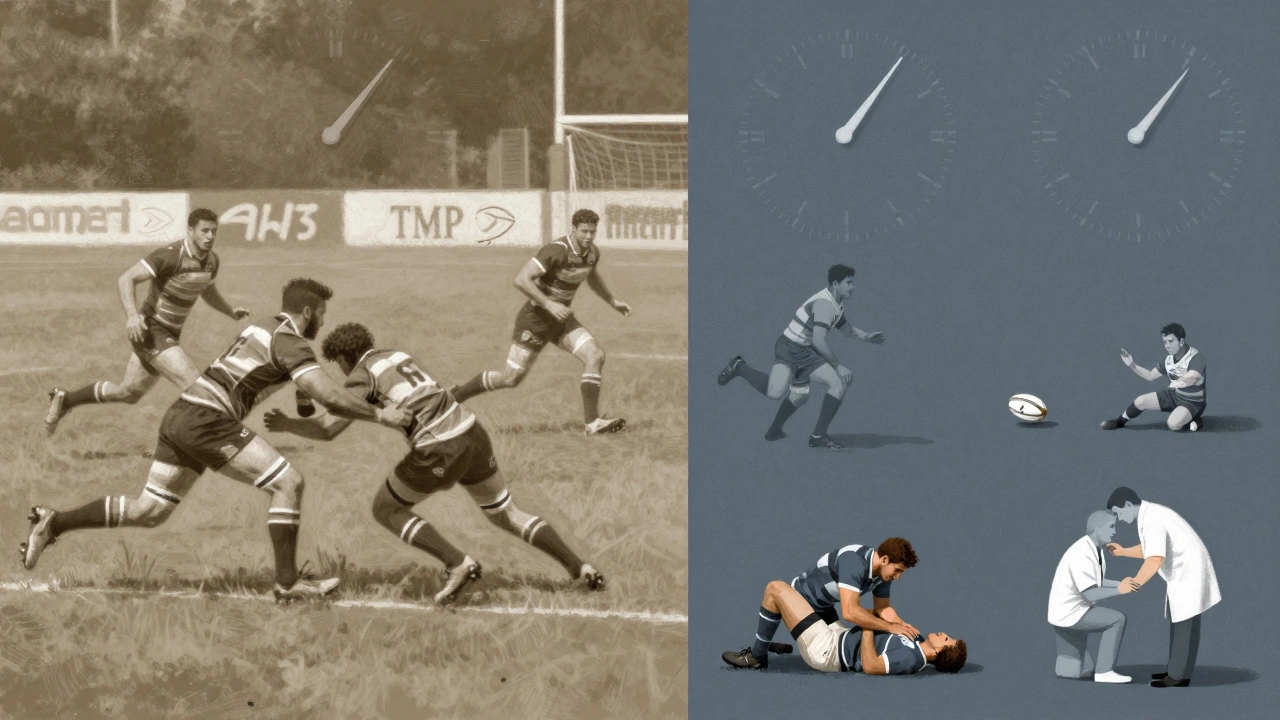
- Injuries: If a player is down and needs medical help, the clock stops. This is non-negotiable. Rugby is a physical sport, and player safety comes first. Even a minor knock can pause the game for 2 to 5 minutes.
- Substitutions: Teams get up to 8 replacements per match. Each time a player comes off or on, the clock stops for about 30 to 60 seconds. That’s 4 to 8 minutes just from swaps.
- Try conversions: After a try, the scoring team gets a chance to kick for 2 extra points. The clock stops until the kick is taken and completed-whether it’s good or missed.
- Penalty kicks: If a team opts for a penalty kick at goal instead of a scrum, the clock stops until the kick is taken.
- Video referee reviews: The TMO (Television Match Official) checks for tries, foul play, or knock-ons. These reviews can take 1 to 3 minutes each. In tight matches, there can be 3 or 4 reviews.
- Ball out of play: While the clock doesn’t stop for every throw-in or lineout, referees often pause it if the ball goes far out of bounds or if there’s confusion over possession.
These aren’t glitches-they’re features. Rugby’s structure prioritizes player welfare and accurate decision-making over keeping the game moving at all costs. That’s why you’ll never see a rugby referee rush a player off the field after a head injury, even if the clock is ticking.
How Much Extra Time Is Normal?
According to World Rugby’s official match statistics from the 2024 Six Nations and Rugby Championship, the average match duration was 94 minutes. The shortest game lasted 88 minutes; the longest hit 107 minutes.
Here’s a breakdown of average stoppage time per match:
| Stoppage Reason | Average Time Added per Match |
|---|---|
| Injuries | 6-8 minutes |
| Substitutions | 4-6 minutes |
| Try Conversions | 2-3 minutes |
| Penalty Kicks | 1-2 minutes |
| TMO Reviews | 3-5 minutes |
| Other (ball out, delays) | 1-2 minutes |
That’s 17 to 26 minutes of added time on average. So if you’re watching a match and it hits 95 minutes, you’re not seeing a glitch-you’re seeing rugby working as intended.
Why Not Just Keep the Clock Running?
You might think: why not just let the clock run like in soccer? The answer is simple-rugby isn’t soccer.
First, rugby is a high-impact sport. Players collide at speed, often without warning. Stopping the clock gives medics time to assess injuries properly. In 2023, World Rugby reported that 68% of head injury assessments took place during stoppages, and nearly all were completed safely because the clock was paused.
Second, rugby is a game of precision. A try might be disallowed because a player’s toe was just a centimeter over the line. The TMO needs time to check multiple camera angles. Rushing that decision could change the outcome of a championship match.
Third, rugby fans don’t mind the breaks. In fact, they expect them. The pauses let fans catch their breath, analyze the play, and get a drink. It’s part of the rhythm. In Bristol, where rugby is practically a religion, fans don’t complain when the game runs long-they just grab another pie and wait for the next scrum.
What Happens in Extra Time?
When a match ends in a tie during knockout stages-like in the Rugby World Cup-the rules change. Extra time is added: two 10-minute halves with a 5-minute break in between. If it’s still tied, it goes to sudden death: the first team to score wins. That’s when the clock really starts to feel endless.
In the 2023 Rugby World Cup quarterfinal between France and Ireland, the game went to extra time. The final whistle blew at 112 minutes. That’s 32 minutes over the base 80. Fans were exhausted. Players were collapsing. But the result was fair-and that’s what matters.
Is This Fair to Viewers?
Some say rugby’s long games are a turnoff for new fans. But here’s the thing: rugby doesn’t need to be fast to be exciting. The drama builds slowly. A scrum five meters from the try line, the push, the grunt, the ball popping out-it’s cinematic. The pauses make the action more intense.
And if you’re watching on TV, the broadcasters pad the breaks with analysis, replays, and interviews. The extra time isn’t dead air-it’s content. In fact, TV ratings for rugby matches in the UK are higher than for many soccer games during the same window.
Plus, rugby’s time structure rewards patience. If you’re watching live, you learn to read the game. You know that when the referee holds up a finger, it’s not the end-it’s just a pause. And when the clock hits 85, you know the real game is just beginning.
Bottom Line: It’s Not a Bug, It’s a Feature
Rugby doesn’t go over 80 minutes because it’s broken. It goes over because it’s designed to be human. The clock stops for injuries, for fairness, for accuracy, and for safety. The extra minutes aren’t wasted time-they’re the cost of doing the sport right.
So the next time you see a match run past 90 minutes, don’t groan. Appreciate it. That’s rugby honoring its players, its rules, and its history. And if you’re watching from a pub in Bristol, you’ll probably raise your pint and say, ‘That’s how it’s meant to be.’
Why doesn’t rugby use a running clock like soccer?
Rugby doesn’t use a running clock because player safety and accurate decision-making are prioritized over continuous play. The clock stops for injuries, substitutions, conversions, and video reviews to ensure fair outcomes and proper medical care. Unlike soccer, rugby values the integrity of each moment over speed.
How long is a typical rugby match including stoppages?
A typical professional rugby match lasts between 90 and 100 minutes from kickoff to final whistle. The 80 minutes of playing time are extended by an average of 15 to 25 minutes due to stoppages like injuries, substitutions, conversions, and TMO reviews.
Do all rugby competitions have the same time rules?
Yes, all World Rugby-sanctioned matches follow the same time rules: 80 minutes of playing time with a stoppage clock. This applies to international tests, Six Nations, Rugby Championship, and World Cups. Some amateur or youth leagues may simplify rules, but the professional standard is consistent worldwide.
What happens if a team delays the restart after a stoppage?
If a team deliberately delays restarting play-like holding the ball too long after a penalty-the referee can issue a warning or even award a penalty to the opposing team. Time-wasting is penalized to keep the game flowing fairly.
Why do rugby matches feel longer than soccer matches?
Rugby matches feel longer because the game has more natural stoppages-scrums, rucks, lineouts, and injury checks-compared to soccer’s more fluid structure. Even though soccer games can run over 90 minutes too, the breaks are shorter and less frequent, making rugby’s pauses more noticeable and impactful.
If you’re new to rugby, the extended match time might surprise you. But once you understand why the clock stops, you’ll start to appreciate the rhythm. It’s not about how fast the game moves-it’s about how much happens in every second it does.